
How To Use A Quad Cane: Essential Tips For Safe Mobility

Figuring out how to use a quad cane is straightforward, [...]
Figuring out how to use a quad cane is straightforward, but the first real step is making sure it's the right piece of equipment for you. It's designed for people who need more stability than a standard single-point cane can give them, but who don't quite need the full support of a walker. This makes it a fantastic middle-ground solution for boosting your safety and keeping your independence.
Is A Quad Cane The Right Mobility Aid For You?

Choosing the right mobility aid is one of the most important decisions you'll make for moving around safely. While a regular cane offers a bit of support, a quad cane gives you a much wider and more stable base to rely on, all thanks to its four small feet. That design is what makes all the difference.
Think of it this way: a single-point cane is for minor balance issues. A quad cane, on the other hand, is built for people facing more significant stability challenges. It’s especially helpful for those navigating recovery from an injury or managing a chronic condition.
Who Benefits Most From A Quad Cane?
From my experience, a quad cane is often recommended when balance and the ability to bear weight are the main concerns. It gives a sense of security that a single-tip cane just can't provide. See if any of these common scenarios sound familiar:
- Post-Stroke Recovery: For someone with weakness on one side of their body (hemiparesis), a quad cane delivers the firm base they need to walk with confidence.
- Generalized Weakness: If you often feel unsteady on your feet because of muscle weakness or fatigue, the four-point base offers constant, reliable support.
- Balance Impairments: Conditions affecting the nervous system or inner ear can throw off your equilibrium, making a quad cane a much safer choice than a standard one.
The numbers back this up, too. In the entire canes and crutches market, canes made up the largest share at over 52.07% in 2023. Quad canes are a crucial part of that, offering a greater weight-bearing capacity and a wider base that's invaluable for anyone with limited function on one side.
The Perfect Middle-Ground Solution
A quad cane truly bridges the gap between a standard cane and a walker. Walkers offer maximum stability, but let's be honest, they can be bulky and awkward in tight spaces or crowded rooms. For anyone who needs more support than a regular cane but still wants to move around more freely than a walker allows, the quad cane is a great fit.
One of the best things about a quad cane is that it can stand on its own. This simple feature is a game-changer—it frees up your hands so you can safely push up from a chair or manage other tasks without your cane clattering to the floor.
As you think about whether a quad cane is right for you, remember that other home modifications, like a walk in shower for seniors, can also make a huge difference in your daily safety and independence. Creating a supportive environment is just as critical as picking the right equipment. And if you find your needs are more extensive, you might want to look into our walkers and rollators in St. Petersburg, FL.
Getting The Perfect Fit For Your Quad Cane
Using a quad cane that isn't sized for you is a recipe for trouble. It's like trying to walk in someone else's shoes—awkward, uncomfortable, and just plain unsafe. An improperly adjusted cane can wreck your posture, strain your shoulder, and even lead to back pain, which is the last thing you need.
Taking a few moments to get the fit just right is the most critical step you can take before you even think about walking with it.
One small but crucial tip people often overlook: always wear your everyday walking shoes when you adjust the cane. The height of the sole makes a bigger difference than you'd think. Sizing your cane while barefoot or in house slippers will throw the measurement off every time.
Finding The Correct Height
First, stand up as straight as you comfortably can, letting your arms hang naturally at your sides. Place the quad cane on your stronger side, right next to your foot. The very top of the cane's handle should line up with the crease in your wrist.
Once you have it set to that height, grab the handle. Your elbow should have a slight, comfortable bend to it—we're looking for about a 15 to 20-degree angle. If your arm is locked straight, the cane is too long. If you're bending your elbow a lot, it's too short. That small bend is the sweet spot that lets you push down for support without putting unnecessary strain on your joints.
A correctly sized cane helps you walk tall and upright. If you find yourself hunching over to reach the handle or leaning awkwardly to one side, that’s a red flag. It means the height is off and needs to be adjusted immediately for your safety and comfort.
To make sure you've got it right, here is a quick checklist to run through.
Quick Quad Cane Sizing Checklist
Use this checklist to confirm your quad cane is adjusted correctly for optimal safety and comfort.
- Handle Height: Lines up with the crease of your wrist when your arm hangs naturally. This prevents you from hunching over or reaching too high, which can cause shoulder and back pain.
- Elbow Bend: A slight 15-20 degree bend when holding the grip. This allows you to apply downward pressure for support without hyperextending or straining your elbow and shoulder.
- Posture: You can stand up straight without leaning or slouching. A proper fit promotes a natural walking gait and good posture, reducing the risk of strain or further injury.
- Footwear: You're wearing your typical daily walking shoes. This ensures the height is accurate for your everyday activities, as different shoes can alter your height slightly.
Nailing these four points is the foundation for using your cane safely and getting the most benefit from it.
Choosing The Right Base Size
Quad canes generally come in two flavors: small-base and large-base. The best one for you really boils down to how much stability you need versus how much you need to move around in tight spots.
Here’s a quick breakdown to help you decide:
- Small-Base Quad Canes (SBQC): These have a more compact, almost square footprint. They offer a huge step up in stability from a standard single-point cane but are still nimble enough for narrow hallways, small bathrooms, or weaving through a crowded store. It's a fantastic middle ground for someone who needs solid support but doesn't want to feel weighed down.
- Large-Base Quad Canes (WBQC): With their wider, rectangular base, these canes are the champions of stability. If your main goal is preventing falls and you need the most robust support you can get, this is your best bet. They are a bit heavier and can feel clunky in tight quarters, but that rock-solid stability gives incredible peace of mind, especially on uneven ground.
Getting the fit and base size right sets the stage for everything else. Once you know what you need, you can browse a variety of models to find the perfect match when you check out the different mobility aids we have in our online shop.
Getting The Hang Of Walking With Your Cane
Now that your quad cane is sized up just right, it’s time to get moving. Learning the proper way to walk with it isn't just about getting from point A to point B—it's about creating a safe, natural rhythm that you don't even have to think about after a while. This rhythm is what gives you the full support of the cane while helping you maintain a healthy posture.
First things first, and this is the big one: the cane goes on your strong side. Hold it in the hand opposite your weaker or injured leg. I know, it feels completely backward at first! But trust me, this is the correct way. It allows the cane to support your weaker side exactly when you need it, creating a stable, wider base as you take a step.
Finding Your Walking Rhythm
With the cane in the right hand, you can start walking. The whole idea is to establish a simple, repeatable three-part motion. The mantra I tell people is: "cane, weak leg, strong leg."
Here's how that looks in practice:
- Move the cane forward first. Just a comfortable, small step's length ahead of you.
- Then, step forward with your weaker leg, bringing it up so it’s even with the cane.
- Finally, push off and step past the cane with your stronger leg. That's one full step.
This sequence keeps you supported at all times. The cane acts as a steady anchor before your weaker leg moves, and your stronger leg provides the power to move you forward. It's a technique used by millions. In fact, the global market for canes and crutches is expected to hit $1.49 billion by 2030. You can find more data on the rising need for mobility aids over on Physio-Pedia.
Good Posture and Staying Safe
A common mistake I see all the time is people putting way too much weight on their cane, hunching over it. Remember, your quad cane is there to help with balance and support, not to carry your entire body weight like a crutch. Do your best to walk upright, using the cane as a guide for stability.
Here's a pro-tip that often gets missed: pay attention to how the base is turned. The flat, straight side of the quad cane's base should always be right up against your body. This keeps the legs from sticking out and tripping you or someone else.
The visual guide below is a great reminder of the fitting process we talked about earlier—it’s the foundation for everything else.
A flowchart illustrates the perfect cane fit process in three steps: shoes on, wrist height, and elbow bend.
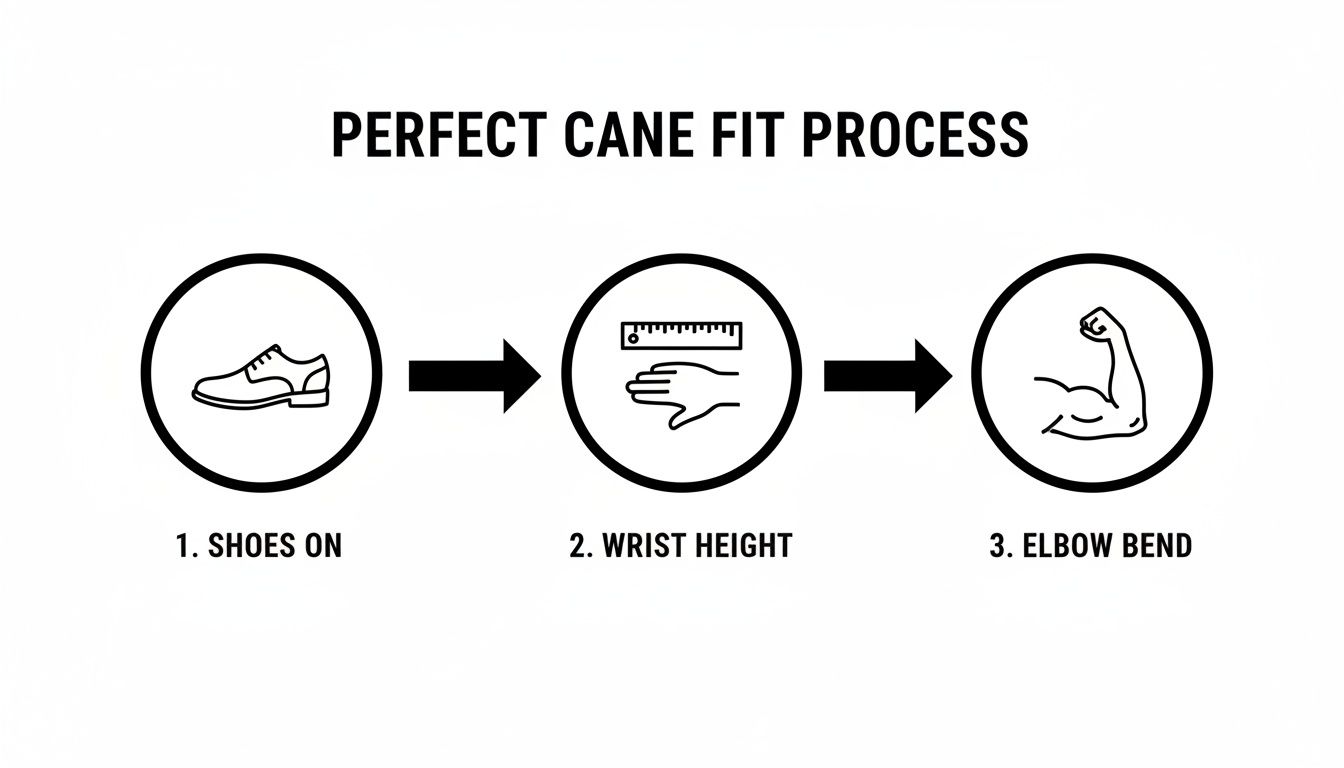
Nailing these three simple checks—shoes, wrist height, and elbow bend—sets you up for success and makes walking safely so much easier.
Once you commit these fundamentals to muscle memory—proper placement, the walking sequence, and key safety checks—you'll build the confidence to get around safely. If you're looking for more advice on mobility and home safety, feel free to browse other articles on our medical equipment blog.
Navigating Stairs, Curbs, And Chairs Like A Pro

Once you've got the hang of walking on a flat surface, the next step is conquering the real world. That means dealing with things like stairs, curbs, and even just getting up from your favorite armchair. These everyday obstacles can feel like major hurdles at first.
But don't worry. The techniques for handling them are straightforward and easy to remember. A little practice is all it takes to build the confidence you need to move through your day safely and with less hesitation.
How To Go Up And Down Stairs
Stairs often look like the biggest challenge, but there’s a simple trick to it. Just remember this little rhyme: "up with the good, down with the bad." This tells you which leg should lead. If there’s a handrail, always use it—it’s your best friend. Hold the rail with one hand and your quad cane with the other.
-
Going Up: Your stronger, or "good," leg goes first. Plant it firmly on the step above you. Next, bring your weaker leg and the cane up to join it on the same step. That’s one down. Repeat the pattern all the way to the top.
-
Going Down: Start by placing your quad cane on the step below you. Then, step down with your weaker, or "bad," leg. Finally, bring your stronger leg down to meet it.
This method is all about biomechanics. Your stronger leg does the tough work of lifting you against gravity, and your weaker leg gets extra support from the cane when you’re moving with gravity.
Safely Getting Over Curbs
Guess what? Curbs use the exact same logic as stairs. As you approach one, just slow down and take a look at the height. For almost any standard curb you’ll encounter, that "up with the good, down with the bad" rule works perfectly.
- To step up onto a curb: First, place your cane securely on the sidewalk above. Step up with your stronger leg, then bring your weaker leg up to join it.
- To step down off a curb: Place your cane on the street level first. Then, carefully step down with your weaker leg, followed by your stronger one.
Key takeaway: Before you shift any of your weight, make absolutely certain all four tips of the quad cane are flat and stable on the ground. This is non-negotiable, especially on uneven surfaces like a cracked sidewalk or a sloped curb cut, where the cane could easily rock and throw you off balance.
Sitting Down And Standing Up From A Chair
This is where many people make a critical mistake: they try to lean on the cane itself for support when sitting or standing. Your quad cane is great for walking, but it's not designed to take your full weight like that. It's an unstable and risky move.
The much safer way is to use the chair for support.
When you want to sit, back up until the back of your legs touch the edge of the chair. You'll know you're in the right spot. Set your cane to the side—it will stand on its own. Now, reach back with both hands and grip the chair's armrests. Use your arms to guide yourself down into the seat slowly and with control.
To stand up, just reverse the process. With your feet underneath you, place both hands on the armrests and push yourself into a standing position. Once you feel steady, then you can reach for your cane. The solid frame of the chair is a far more reliable anchor.
If you find that getting up and down is still a significant challenge, it might be worth exploring other mobility aids. Our guide to wheelchairs in St. Petersburg, FL, for rentals and sales can offer some helpful alternatives.
Common Quad Cane Mistakes And How To Sidestep Them
Knowing the right way to use a quad cane is one thing, but knowing what not to do is just as critical for your safety. From my experience, a few common habits can trip people up (sometimes literally). Let's walk through them so you can build confidence from day one.
The most common mistake I see is people placing the cane too far out from their side. It feels like you're creating a wider base of support, but what you're actually doing is throwing off your center of gravity. You end up leaning and reaching, which is exactly what the cane is supposed to prevent. Keep it close to your body.
Getting The Cane Height Wrong
This one is a big deal. Using a cane that’s too tall or too short can create a whole new set of problems.
If it's too high, you’ll find your shoulder hiked up towards your ear. That gets uncomfortable fast and can lead to neck and shoulder pain. On the flip side, if it's too short, you’ll be hunched over, putting a ton of strain on your back.
A simple adjustment can turn your cane from a source of pain into a source of support. Remember, the handle should line up with the crease of your wrist, giving you a comfortable, slight bend in your elbow.
Here's a pro tip I always give my clients: Before you put any weight on the cane, always double-check that all four tips are flat and firm on the ground. This is non-negotiable, especially on uneven ground like a cracked sidewalk or a sloped ramp where the cane can easily rock and become a hazard.
Putting Your Weight In The Wrong Place
Another common misstep is trying to use the cane to bear your full body weight, particularly when getting up from a chair. A quad cane is there to help you balance, not to function like a crutch.
Trying to push yourself up using the cane is a recipe for a fall because it can easily tip. Always use the sturdy armrests of a chair or couch to push yourself into a standing position first, then grab your cane for support.
The demand for these aids shows just how vital they are. The global market for quad canes was valued at $20.039 million in 2021 and is projected to hit $27.243 million by 2025. That's a lot of people relying on these tools to get around safely.
By consciously avoiding these few mistakes—reaching too far, using the wrong height, and leaning on it too heavily—you'll ensure your quad cane is the steady partner it's meant to be. If you run into other specific issues, you might find an answer over in our frequently asked questions section.
Answering Your Quad Cane Questions
Once you've got the basics down, a few practical questions almost always come up. It's totally normal. Here are some of the most common things people ask as they start living with their quad cane day-to-day.
How Do I Know If I Need A Small Or Large Base?
This is probably the most frequent question I hear, and it really boils down to one thing: stability versus agility.
A large-base quad cane (WBQC) is your go-to for maximum support. If your biggest worry is fall prevention and you have significant balance challenges, that wide, sturdy footprint provides an incredibly solid foundation. You'll feel much more secure.
But what if you need to get around in a smaller apartment, a busy store, or a tight bathroom? That's where a small-base quad cane (SBQC) shines. It still offers a huge leap in stability over a standard single-tip cane, but it’s much less clumsy in tight quarters. For a lot of folks, it’s the perfect middle ground.
Here's a simple way to think about it: If your top priority is rock-solid stability, go with the large base. If you need to navigate tighter spaces and value maneuverability, the small base is likely your better bet. Think about your home and where you go most often.
Should I Get A Prescription For My Cane?
Technically, you don't need a prescription to buy a quad cane. But I always, always recommend it.
Having a doctor or, even better, a physical therapist evaluate you is the only way to be certain a quad cane is the right tool for the job. They'll look at your gait, your strength, and your specific mobility issues. This professional assessment is key.
Plus, a prescription is your ticket to getting properly fitted and, most importantly, trained by someone who knows what they're doing. Getting the right device is only half the battle; knowing how to use it safely is what really matters.
What If The Cane Feels Awkward Or Unstable?
Feeling a bit wobbly at first can happen. The number one reason is simple: not having all four tips planted firmly on the floor before you put your weight on it. Always take that extra second to make sure it's sitting flat, especially if the ground isn't perfectly level.
The next most common culprit is placement. Remember to keep the flat side of the base right up against your body—this stops it from becoming a trip hazard. And a reminder: the cane goes on your stronger side, moving with your weaker leg. This might feel counterintuitive, but it’s the biomechanically correct way to give your body the support it needs.
Lastly, just double-check the height. A cane that's even an inch too high or too low will completely throw off your posture and make you feel unsteady on your feet.
Can I Travel With My Quad Cane?
Of course! They're made for real life, and that includes getting out and about. One of the best things about a quad cane is that it stands up on its own, which is a lifesaver when you're waiting in a line, sitting down at a restaurant, or need to free up your hands.
If you’re flying, your cane is considered a medical device and doesn’t count against your carry-on limit. You can bring it right to the gate and onto the plane. For car trips, it's easy enough to pop in the trunk or backseat. Just find a spot where it won’t slide around and become a hazard if the driver has to brake suddenly.
Learning to use a quad cane the right way is a huge step toward staying safe and independent. If you have more questions or want to see which options might be right for you, the team here at Affinity Home Medical Equipment is ready to help. We've been serving this community for over 20 years, and we'd be happy to share our expertise.
Visit us online to learn more and see our full range of products.
Share This Article

Written by : lori@netcodesign.com
Follow Us
Latest Articles

October 14, 2026

October 14, 2026

October 14, 2026
