
Knee Scooter Vs Crutches Which Is Right For Your Recovery

When you’re recovering from a foot or ankle injury, the [...]
When you’re recovering from a foot or ankle injury, the choice between a knee scooter and crutches is one of the most important decisions you'll make for your comfort and independence. A knee scooter lets you glide along, supporting your injured leg on a wheeled platform, which takes almost no effort and keeps your hands free. On the other hand, crutches demand a ton of upper body strength to lift and swing your entire body weight, which can get exhausting and uncomfortable fast.
Choosing Your Mobility Aid: Knee Scooter or Crutches
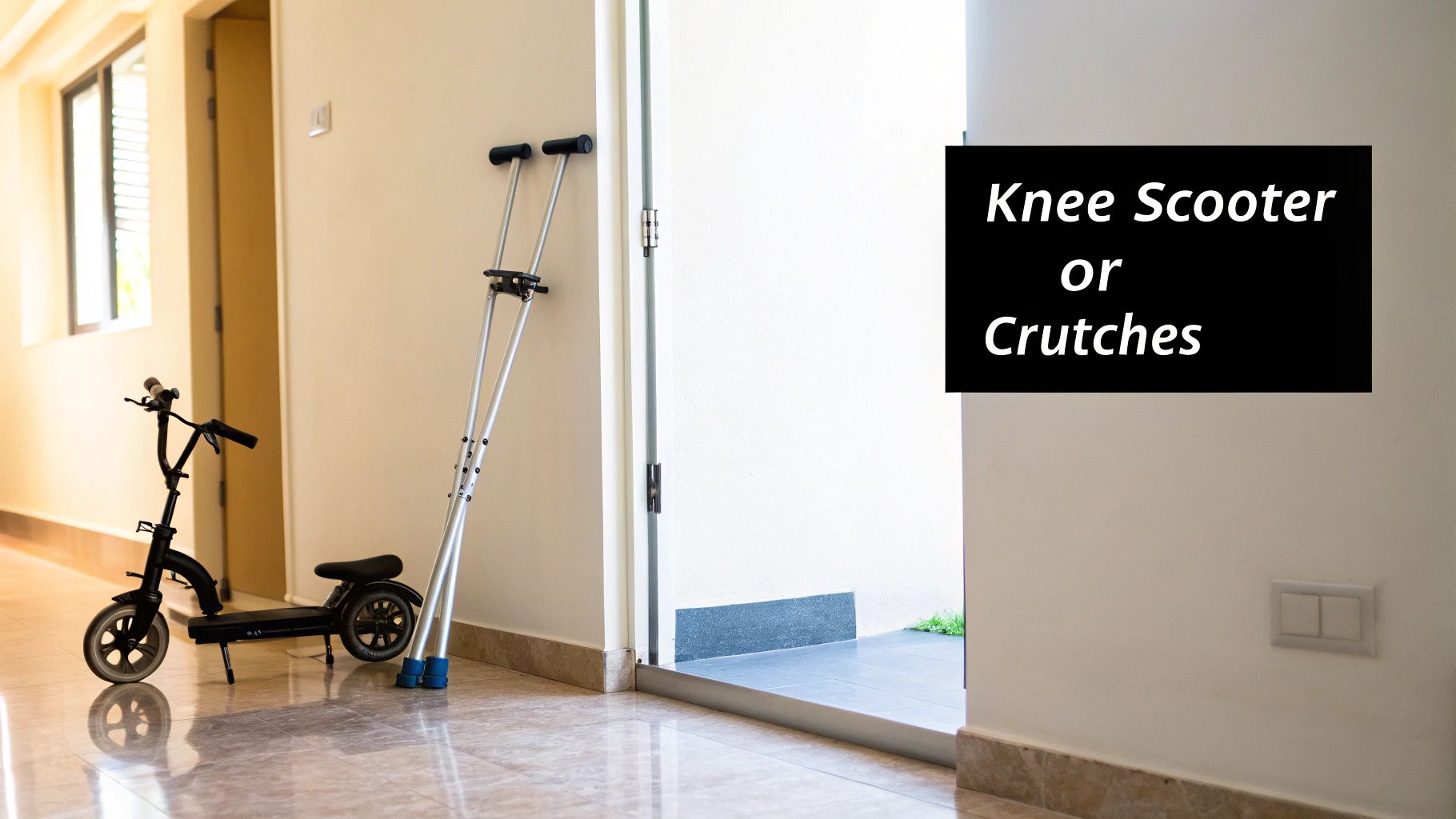
Recovering from a lower leg injury boils down to one major challenge: how do you get around without putting any weight on it? For years, the only real answer was a pair of old-school underarm crutches. But today, you have much better options that can make your recovery a whole lot smoother.
The biggest difference comes down to how they work and how much energy they take. Crutches force you to use your arms, shoulders, and core to hoist your entire body with every single step. It’s a workout, and it often leads to sore hands, wrists, and chafed underarms—not to mention the constant risk of slipping.
A knee scooter, or knee walker, is built on a totally different idea. It supports just your injured leg on a padded rest while your good leg pushes you along. This design saves your energy, makes you far more stable, and frees up your hands for everyday things.
Key Differences at a Glance
Before we get into the nitty-gritty, here’s a quick rundown of how these two stack up. This should give you a clear picture of what to expect during your recovery.
- Mobility Style: A knee scooter provides a smooth, rolling glide. Crutches require a tiring, stop-and-start hopping motion.
- Stability: With a stable, four-wheeled base, a knee scooter dramatically cuts down your risk of falling. Crutches only give you two small points of contact with the ground.
- Energy Use: Gliding on a scooter uses very little energy, letting you save it for healing. Crutches are a constant upper-body workout that can leave you wiped out.
- Independence: A knee scooter leaves your hands free to carry a cup of coffee, your phone, or a bag. Crutches tie up both hands, making even simple tasks a huge pain.
Choosing between a scooter and crutches isn't just about what's comfortable. It's about preserving your quality of life while you heal. The right choice is the difference between feeling stuck and feeling independent.
It’s important to know that we work directly with our customers to provide simple, upfront pricing for rentals and purchases. We do not work with or bill any insurance companies. This allows us to avoid confusing billing or paperwork. As we compare these options, you'll see the practical benefits of each. And if you're exploring all your options, you can also learn more about other mobility aids like walkers and rollators in St. Petersburg, FL to find the perfect fit for your needs.
Comparing Daily Mobility And Independence
When you're recovering from a lower-leg injury, your choice of mobility aid has a huge impact on your daily life. It’s not just about getting from your bed to the couch; it’s about holding onto your energy, your freedom, and your sense of normalcy. Looking at knee scooters versus crutches, it's clear each one offers a completely different day-to-day experience.
Crutches work on a simple but very demanding principle: lift your body, swing forward, and plant. This constant stop-and-go movement requires a surprising amount of upper body and core strength. Every trip, even just to the kitchen, becomes a workout that can leave you feeling drained pretty quickly.
A knee scooter, on the other hand, is built for smooth, continuous motion. You just rest your injured leg on the padded platform and push with your good leg to glide across the floor. This rolling action saves a ton of energy, which makes traveling longer distances feel much less like a marathon.
Hands-Free Living: A Major Advantage
One of the biggest real-world differences is what you can do with your hands. When you’re on crutches, both hands are completely tied up. Simple things like carrying a cup of coffee, holding a grocery bag, or even answering your phone become a frustrating logistical challenge.
This is where the knee scooter really shines. Because it’s stable enough to support you without needing your hands, you get them back. You can move through your office holding a laptop, do a bit of shopping, or even walk the dog, restoring a level of independence that crutches just can't offer.
The ability to handle everyday tasks on your own is a huge part of a positive recovery. A knee scooter lets you keep up with your routines, which makes a massive difference for your mental well-being and the overall healing process.
Navigating Different Environments
Think about your daily routine. If you work in an office with long hallways or love getting out to local parks in St. Petersburg, a knee scooter lets you cover that ground efficiently and without getting worn out. Its wheels are perfect for flat, open spaces, whether you're inside or out.
However, crutches definitely have the upper hand when it comes to tight spaces or stairs. Their narrow profile allows you to get around where a scooter’s turning radius is just too wide. If you live in a multi-level home, crutches are pretty much essential for getting between floors, even if you use a scooter for getting around on each level. For anyone facing longer-term mobility issues that go beyond a simple injury, exploring options in our guide to wheelchairs in St. Petersburg, FL can offer more comprehensive solutions.
Surveys regularly find that a high percentage of users report better maneuverability and less fatigue with knee scooters compared to crutches. Crutches are also linked to a higher risk of falls and often cause painful underarm sores. In a place where recovery from vehicle accidents or sports injuries is common, a knee scooter is often the superior choice for bouncing back quickly.
Evaluating Safety And Stability At Home
Your safety at home during recovery is everything. When you’re weighing a knee scooter against crutches, the biggest difference really comes down to stability. A knee scooter gives you a wide, steady base on wheels, which drastically cuts down on the wobbling that makes using crutches so unnerving.
Crutches, by comparison, only give you two very small points of contact with the floor. You’re constantly having to use your core and upper body just to stay upright. That can feel pretty precarious, especially on slicker surfaces like kitchen tile or hardwood floors.
This image really drives home the difference in effort and freedom between the two.
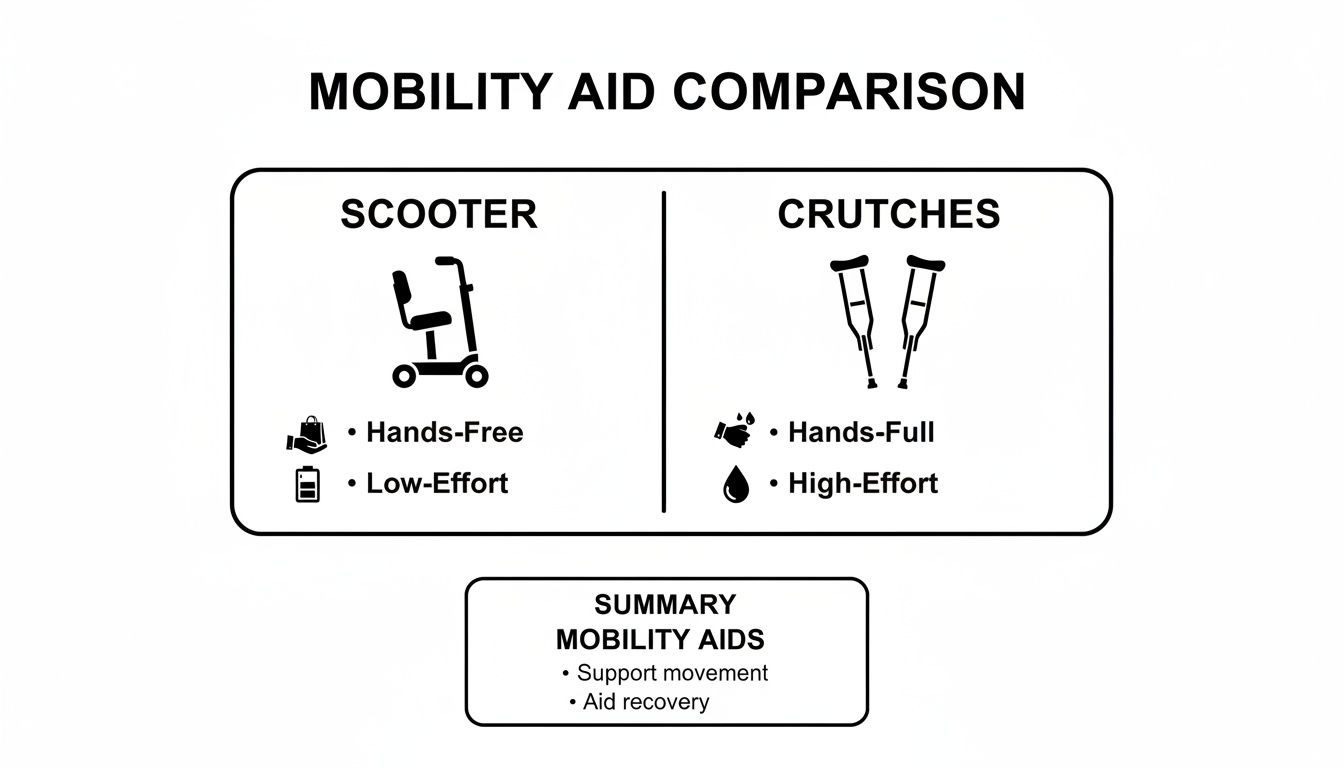
As you can see, the trade-off is clear: knee scooters are built for a low-effort, hands-free experience, while crutches are a high-effort tool that ties up your hands completely.
Understanding Inherent Risks
Let's be realistic—every mobility aid has its own risks. With crutches, the main dangers come from sheer physical strain. All that pressure on your hands, wrists, and underarms often leads to nerve pain, blisters, and just plain exhaustion.
That fatigue is a real problem. It makes a slip or a misstep much more likely, which could easily lead to a fall and a brand new injury. Crutches are physically demanding, and over a long recovery, they can really wear you down.
The best mobility aid is the one you can use confidently, without it causing you more pain. The whole point is to help you heal, not create new problems.
Knee scooters provide better stability and comfort, which helps you avoid the upper body strain that so many crutch users complain about. For older adults, particularly here in the St. Petersburg area, that stability can mean the difference in avoiding falls that can complicate recovery.
Navigating Household Obstacles
While knee scooters are champions on flat, open surfaces, they do have their own set of challenges inside a house. Their turning radius is wider, so getting around tight corners, narrow hallways, or cluttered rooms can take some getting used to.
To make your home scooter-friendly, you’ll want to do a little prep work:
- Clear Pathways: Move some furniture, get boxes out of the way, and create clear, wide paths through your most-used rooms.
- Secure Rugs: Tape down the edges of your area rugs or just roll them up for a while. You don't want a wheel catching an edge and bringing you to a sudden stop.
- Manage Thresholds: Be careful with the thresholds between rooms. It’s best to approach them slowly and straight-on so you don't get hung up.
Crutches, on the other hand, can get through those tight spaces a bit easier, but they pose a much greater risk on stairs. A strategy we often recommend for people in multi-level homes is to use a knee scooter on the main floor and keep a pair of crutches nearby just for handling the stairs.
Deciding Based On Real-World Scenarios
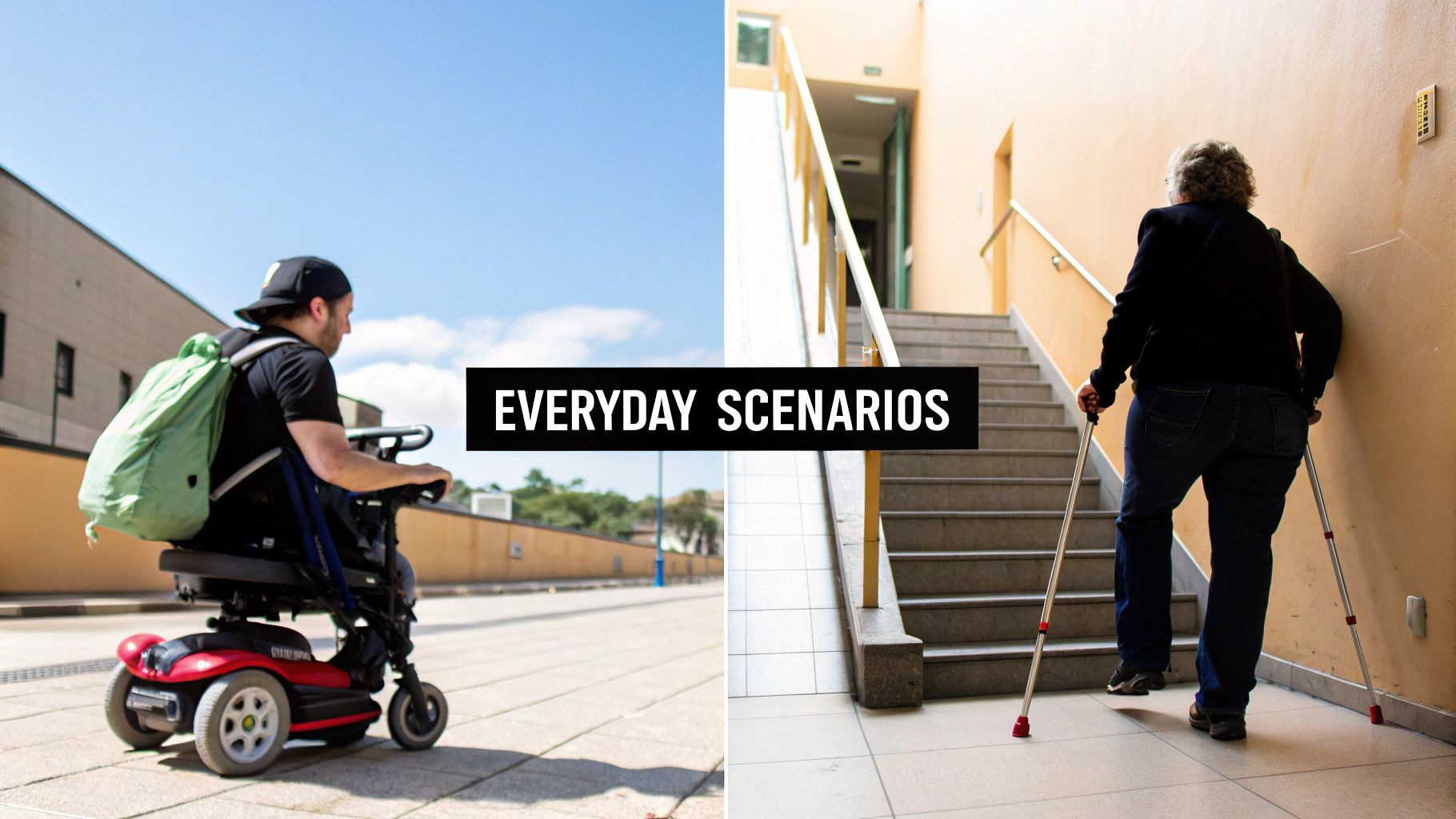
On-paper specs and pro/con lists only get you so far. The real test is how a mobility aid fits into your life. The right choice needs to work with your daily routine, your home layout, and what you’re physically capable of doing. A theoretical advantage means nothing if the device you pick just makes your day-to-day harder.
So, let's step away from the abstract and look at how these two options perform in common, everyday situations. By walking through a few scenarios, you can get a much clearer picture of which tool will be a better partner for your recovery.
The Office Professional
Picture this: you're heading back to work after an injury. Your office has long corridors, you grab lunch in a spacious cafeteria, and you move between conference rooms for meetings. You're covering a lot of ground, all of it on smooth, flat floors.
In this setting, the knee scooter is the clear winner. It lets you glide from your desk to the printer and back without breaking a sweat, saving your energy for the actual job. Even better, it leaves your hands free. You can carry your laptop, a notebook, or that essential morning coffee without a second thought, helping you stay productive and independent.
Trying to do the same on crutches would be exhausting. Every trip down the hall becomes a workout, and simple tasks like carrying files turn into a clumsy balancing act. The scooter keeps you moving efficiently; crutches can slow you down.
The Busy Parent At Home
Now, imagine you're a parent trying to run a household, possibly with kids underfoot. Your home might have multiple floors, narrow hallways, and a constant obstacle course of toys. Your movements are short and frequent—from the kitchen to the living room, then up the stairs to check on a sleeping child.
This is where crutches often have the edge. Their narrow profile is perfect for squeezing through tight spaces and navigating cluttered rooms where a scooter’s turning radius would be a major headache. The biggest factor? Crutches are your only real option for getting up and down stairs, which is a dealbreaker in a multi-story home.
Your home environment is the ultimate test for a mobility aid. The best choice is the one that minimizes frustration and maximizes safety within your unique layout.
A knee scooter could be a lifesaver on the main floor for tasks like cooking, but it can't get you upstairs. For many people living in a two-story home, a hybrid approach is the most realistic solution: a scooter for one level and crutches for tackling the stairs.
The Active Community Member
Finally, think about someone determined to stay involved in their community during recovery. This means trips to the grocery store, getting some fresh air at a local park, or attending an event at the community center. These outings require covering longer distances and often involve carrying things.
For this kind of active lifestyle, a knee scooter offers far more freedom and endurance. It turns what would be an exhausting ordeal on crutches into a manageable, even pleasant, trip. You can attach a basket and easily browse the aisles at the store or enjoy a stable ride along a paved park trail.
Attempting to keep up this pace on crutches would be a serious physical challenge. The strain on your arms and shoulders would likely cut your outings short. And forget about grocery shopping without help—you simply can't carry anything. The scooter empowers you to stay connected, whereas crutches can sometimes make you feel stuck at home.
Understanding The Costs: Renting vs. Buying
When you're dealing with a lower leg injury, the last thing you need is financial stress. The decision between a knee scooter and crutches isn't just about comfort; it's also about what makes the most sense for your wallet. This often boils down to a simple question: should you rent or buy?
While standard crutches might seem like the cheapest option upfront, they come with hidden physical costs—think sore underarms, tired hands, and even the risk of a secondary injury from a stumble. On the other side, buying a top-notch knee scooter is a bigger investment, which can feel like overkill for a recovery that only lasts a few weeks. That’s where renting shines as a practical, common-sense solution.
How Long Is Your Recovery?
Time is the biggest factor here. How long will your doctor have you non-weight-bearing? If you're looking at a shorter-term recovery—say, 4 to 8 weeks for a straightforward ankle sprain or minor foot surgery—renting is almost always the more logical and budget-friendly path.
Renting gets you a high-quality, professionally maintained knee scooter for the exact time you need it, without locking you into the full purchase price. You get all the mobility and comfort benefits without the long-term commitment. Of course, if you're facing a recovery that stretches over several months or is indefinite, buying eventually becomes the smarter financial move.
Clear Pricing for Your Budget
We believe in keeping things simple so you can focus on healing. That's why we do not accept insurance. By dealing directly with you, we can offer transparent, straightforward pricing without the headaches and delays often associated with insurance claims. You’ll know the exact cost from day one, whether you’re renting for a week or a month, or deciding to purchase.
This direct approach puts you in control, allowing you to make the best financial choice for your situation without worrying about hidden fees or surprise bills. Our priority is to help you get moving again, quickly and affordably. To see all the flexible options we offer, take a look at our guide to St. Petersburg medical equipment rentals.
The true value of a knee scooter isn't just about money. They virtually eliminate the upper body strain that a large percentage of crutch users complain about. More importantly, they reduce the risk of falling. This added stability is often connected to a more confident and speedy healing process.
Your Local Mobility Solution In Pinellas County
When you're suddenly sidelined by an injury, the last thing you want is a long wait for the right equipment. Getting a mobility aid shouldn't be a week-long ordeal. That's why having a local expert to walk you through the knee scooter vs. crutches decision is so important for anyone in St. Petersburg and the greater Pinellas County area.
Working with a local team means you get back to your life faster and with more confidence. Instead of guessing with an online order, you get real, hands-on guidance from people who know this equipment inside and out. We're here to help you match the right device to your specific injury, your home layout, and your daily routine.
Personalized Service From Local Experts
Getting the right device is only half the battle—a proper fit is essential for a safe and comfortable recovery. Our team does more than just hand you a box. We'll take the time to size your knee scooter correctly, showing you exactly how to adjust the handlebar height and how to use the brakes effectively.
A properly fitted mobility aid is the foundation of a safe recovery. Our goal is to ensure you leave feeling confident and secure with your choice, knowing it’s perfectly adjusted for you.
Every recovery journey is different. We'll give you practical advice to help you sidestep the common issues that can cause discomfort or even re-injury. It’s a personal touch and level of expertise you just don't get from a faceless online store.
Convenience When It Matters Most
We get it—when you're hurt, you need a simple, fast solution. Our rental programs are built to be flexible, whether you need a scooter for a single week or for a couple of months. Renting saves you the cost of buying a piece of equipment you'll only need for a short time.
For anything we have in stock, we offer same-day pickup. There’s no waiting around when you need to get moving again. We've been a part of this community for over 20 years, and our commitment is to provide real, dependable solutions that help our neighbors regain their independence. Our first priority is always to get you the help you need, right when you need it. For a deeper dive into our policies, you can find more answers to frequently asked questions on our site.
Frequently Asked Questions
Choosing between a knee scooter and crutches brings up a lot of practical questions. Getting solid answers from people who've seen it all is the best way to feel good about your choice and your recovery plan.
Can I Use A Knee Scooter On Stairs?
Absolutely not. I can't stress this enough—knee scooters are built for flat ground only. Trying to take one up or down a set of stairs is a serious safety risk because the wheels need a level surface to work properly.
What we see work best for people with multi-level homes is a two-part strategy. They'll use the knee scooter to glide around effortlessly on one floor and keep a set of crutches stationed at the bottom or top of the stairs, using them just for that one task.
Is A Knee Scooter Better For Long-Distance Travel?
Without a doubt. For anything more than just a few steps, a knee scooter is vastly superior. Crutches demand a huge amount of upper body strength and will leave you exhausted pretty quickly. A scooter lets you glide along with minimal effort.
This is what makes them a game-changer for navigating bigger spaces like your office, the grocery store, or even just getting out for some fresh air at the park. You get to keep your independence without the constant fatigue that crutches bring.
How Do I Choose Between Renting And Buying A Knee Scooter?
This really comes down to your expected recovery time. For most common injuries where you'll be off your feet for three months or less, renting is almost always the smarter, more economical choice.
Renting gets you a top-notch, well-maintained scooter for precisely as long as you need it, and you don't have to deal with the bigger upfront cost of buying. Now, if you're looking at a very long or even indefinite recovery, that's when purchasing might make more sense as a long-term investment.
Do You Take Insurance For Rentals Or Purchases?
We've found that dealing with insurance can add a lot of headaches and delays to getting you what you need, so we keep things simple. We do not take or bill any insurance plans. Our model is direct-to-consumer, which means you get clear, upfront pricing without wading through paperwork and waiting for approvals.
This way, you know the exact cost from day one. You can make a clear financial choice for your recovery without worrying about hidden fees or surprise bills later on.
Our priority is getting you the right equipment quickly and affordably. By handling things directly, we can provide a smooth, straightforward experience that lets you focus on what's most important: healing up.
Ready to figure out the best way to get around during your recovery? The team at Affinity Home Medical Equipment is here to help you get moving again with flexible rentals and real-world advice. Explore our mobility aids and regain your independence today.
Share This Article

Written by : lori@netcodesign.com
Follow Us
Latest Articles

October 13, 2026

October 13, 2026

October 13, 2026
