
A Guide To Medical Canes Walking For Better Mobility

Does the thought of taking a walk feel more daunting [...]
Does the thought of taking a walk feel more daunting than it used to? For many, reaching for a walking cane feels like admitting defeat, but I see it differently. A cane isn't about giving up; it's about taking back control and stepping out with confidence again.
Your First Steps Toward Renewed Mobility and Freedom
Choosing to use a walking cane is a powerful, proactive move to keep you safe and self-assured on your feet. Think of this guide as a friendly conversation about how this simple tool can make an immediate difference, helping you stay active and enjoy your life. A cane isn't a crutch; it's a symbol of your strength and determination to stay independent.
Why Choose a Medical Cane?
At its core, a medical cane gives you stability and takes some of the burden off your joints. It's like having a reliable third point of contact with the ground, which instantly widens your base of support and makes you feel steadier with every single step. That little bit of extra help can be a game-changer.
Here's what a cane really does for you:
- Improved Balance: That extra contact point is your anchor. It dramatically cuts down your risk of a fall, especially when you're navigating tricky sidewalks or uneven ground.
- Reduced Joint Strain: A cane lets you shift your weight, easing the pressure on a sore hip, a weak knee, or a tender ankle. It can make a huge difference in your pain levels.
- Increased Confidence: When you feel stable, you worry less. You can tackle the grocery store, walk around your neighborhood, and move through your own home with a newfound sense of security.
The Growing Need for Mobility Support
If you're considering a mobility aid, you are far from alone. The demand for these devices is growing fast. In fact, the medical walking canes market is expected to hit an estimated $2.5 billion by 2025. This isn't surprising when you think about it—more people are living longer and are rightfully focused on staying active and independent for as long as possible.
As you start on this path, remember that a cane is just one piece of the puzzle. It's also a great time to focus on improving flexibility and mobility through gentle exercises.
Sometimes, your needs might point toward a device with even more support, like a walker. You can learn about your options by checking out our guide to walkers and rollators in St. Petersburg, FL. We keep things simple here—our pricing is clear and upfront. We do not work with insurance, which means no red tape or delays in getting the equipment you need.
Finding Your Perfect Match In A Walking Cane
Choosing a medical walking cane isn't about just picking one off the shelf; it’s about finding a reliable partner for your mobility journey. The right cane should feel like a natural extension of your body, providing just the right amount of support without getting in the way. It’s a very personal choice.
Think of it like picking the right tool for a job. You wouldn't use a sledgehammer for a finishing nail, right? The same logic applies here. Each cane is designed for a specific level of support, from a little extra balance to significant weight-bearing assistance. Let's break down the most common types.
The Single-Point Cane: Your Reliable Daily Companion
The single-point cane is the classic, the one most people picture. It’s your go-to for everyday stability. Imagine it as a trusted friend offering a steadying hand when you're feeling just a bit off-balance.
Because it's lightweight and has a single tip, it's incredibly easy to handle in crowded places like a doctor's office or a narrow hallway at home. This is the perfect choice for someone who needs a little confidence boost, is dealing with minor joint pain, or is recovering from a small injury.
The Offset Cane: The Ergonomic Choice For Better Support
A step up in support is the offset cane. At first glance, it looks a bit different with its J-shaped handle, but that design is pure genius. It positions your hand directly over the cane's shaft, which means your weight is centered properly.
This small tweak allows the cane to bear more of your weight safely and comfortably. The handle is also typically shaped to fit your palm, which is a huge relief for anyone with arthritis or hand weakness. It’s the ideal middle ground for those who need more than a touchpoint for balance.
This simple flowchart can help you decide if a medical walking cane is the right step for your journey.
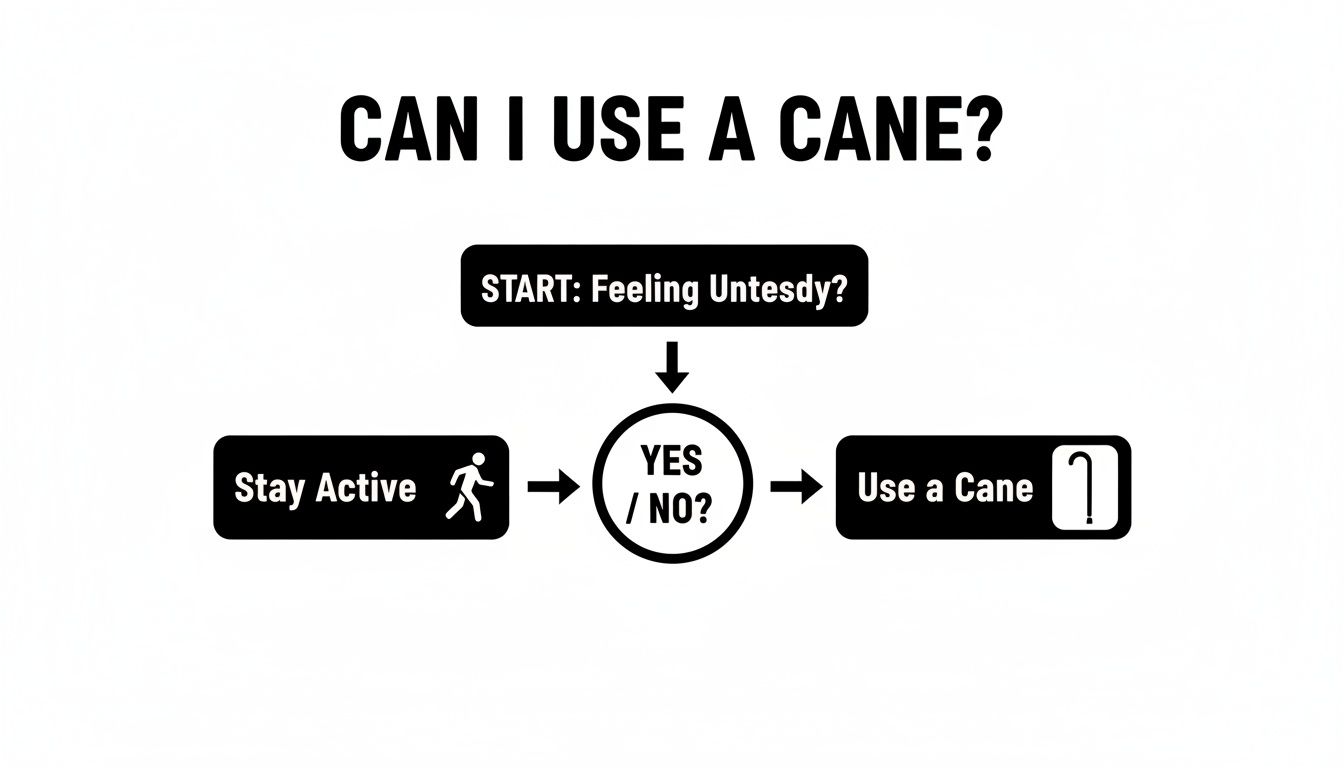
Sometimes a quick visual is all you need. If you're feeling unsteady, a cane is often the key to staying active and safe.
The Quad Cane: The All-Terrain Vehicle For Maximum Stability
When you need serious stability, the quad cane is your answer. With its wide, four-pronged base, this cane is the most stable option available. I like to call it the "all-terrain vehicle" of canes because it provides such a solid, grounded connection to the floor.
A huge perk is that it stands on its own—no more fumbling or trying to prop it against a chair. We typically recommend a quad cane for individuals with significant balance challenges, weakness on one side from a stroke, or those who are transitioning from a walker but aren't quite ready for a single-point cane.
The Folding Cane: The Convenient Traveler
Finally, we have the folding cane. This clever design gives you all the benefits of a standard single-point cane but with one major advantage: it collapses down to a compact size.
You can easily tuck it into a purse, a glove compartment, or a carry-on bag. It’s a fantastic choice for active people who might only need support occasionally—like navigating a busy airport or walking long distances at an event—but don't want to carry a full-size cane all day.
Which Walking Cane Is Right For You?
Choosing the right cane type is the most important step you can take to stay mobile and safe. The design should match your specific needs. Here's a quick comparison of common cane types to help you decide which one best suits your mobility needs, from basic support to enhanced stability.
- Single-Point Cane: Primarily used for light balance aid and minor weight support. It's best for minor balance issues, general fatigue, or slight joint pain.
- Offset Cane: Ideal for moderate weight-bearing and enhanced stability. It's best for arthritis in the hand/wrist or for those who need more consistent support.
- Quad Cane: Provides maximum weight-bearing and superior stability. It's best for significant balance problems or recovery from a major event like a stroke.
- Folding Cane: Offers portable, on-the-go balance support. It's best for active users who need a cane for specific situations or travel.
Once you have an idea of what might work for you, feel free to browse our full selection of medical canes for walking. We believe in a straightforward process, so we offer clear, upfront pricing. Our goal is simply to get you the right equipment, right away.
How to Select the Right Cane for Your Needs
Alright, you've figured out whether a single-point or quad cane is the right starting point. Now comes the part where we dial in the details—the small but crucial choices that turn a simple walking aid into a truly reliable extension of your body.
Getting this right is less about style and more about function. Think of it like a pair of shoes: the right fit makes all the difference in comfort, safety, and how you move through your day.
Choosing the Perfect Handle Grip
The handle is where you and the cane connect, so it has to feel right in your hand. If you're using it all day, a poorly designed grip can cause everything from blisters to serious hand fatigue and wrist pain. It's a make-or-break feature.
Here’s a quick rundown of the most common handle types you'll encounter:
- Fritz Handle: This is that classic, slightly curved T-shape. It's an excellent choice for anyone with arthritis because it lets you grip it without clenching your fingers too tightly.
- Offset Handle: This J-shaped handle is a game-changer for stability. It’s designed to center your weight directly over the cane's shaft, giving you maximum support. Most come with a soft, cushioned grip that's easy to hold onto.
- Palm Grip Handle: These are custom-molded to fit either your right or left hand perfectly. By spreading your weight across your entire palm, it takes a ton of pressure off your wrist and fingers.
The best handle is simply the one that feels most natural for your hand. It should support every step without you even having to think about it.
Selecting the Right Cane Material
The material of your cane dictates its weight and durability, which directly impacts how easy it is to use. While just about any modern cane is built to be strong, the material determines how much effort it takes to lift it with every single step.
Let's look at the main options:
- Aluminum: This is the most common material, and for good reason. It’s light, strong, and almost always adjustable. It's a fantastic, all-around choice that works for most people.
- Carbon Fiber: If you want the lightest possible option without sacrificing strength, carbon fiber is your answer. It weighs next to nothing, which really cuts down on arm fatigue if you're on your feet a lot. Think of it as the premium, high-performance option.
- Wood: A classic wooden cane has a traditional look and a very solid, sturdy feel. They usually aren't adjustable, but they offer dependable support with a timeless aesthetic.
Ultimately, you're looking for that sweet spot—a cane that's strong enough to support you but light enough that it doesn't feel like a burden.
The Importance of the Cane Tip
That little rubber piece at the bottom? It might just be the single most important safety feature on the entire cane. The tip is what grips the ground, providing the traction you need to prevent a slip or fall.
The cane tip is your connection to the world. It’s what keeps you steady on slick tile floors, uneven sidewalks, and everything in between. It’s your first line of defense.
You have to keep an eye on it. Check the tip regularly for cracks or if the treads have worn smooth. A worn-out tip is a major safety hazard, especially on wet surfaces. The good news is that replacement tips are cheap and incredibly easy to pop on. It's a simple bit of maintenance that makes a huge difference. For a little extra stability, you can also find tips with a wider, more robust base.
At Affinity Home Medical Equipment, we focus on providing you with clear, straightforward solutions. We do not take insurance, which allows us to offer transparent pricing and immediate access to the equipment you need without any complicated paperwork or waiting periods. Our priority is to help you find the right cane for your needs quickly and efficiently.
The Critical Importance Of A Proper Cane Fitting
Trying to use a medical cane that doesn't fit right is a lot like wearing someone else's shoes. It’s not just uncomfortable; it’s a recipe for disaster. A cane that's too tall or too short can completely throw off your posture, put unnecessary strain on your joints, and, worst of all, actually make you more likely to fall.
Getting the fit right isn't just a minor detail—it's the single most important step. A perfectly fitted cane becomes an extension of your own body, giving you the solid, reliable support you need to walk with confidence.
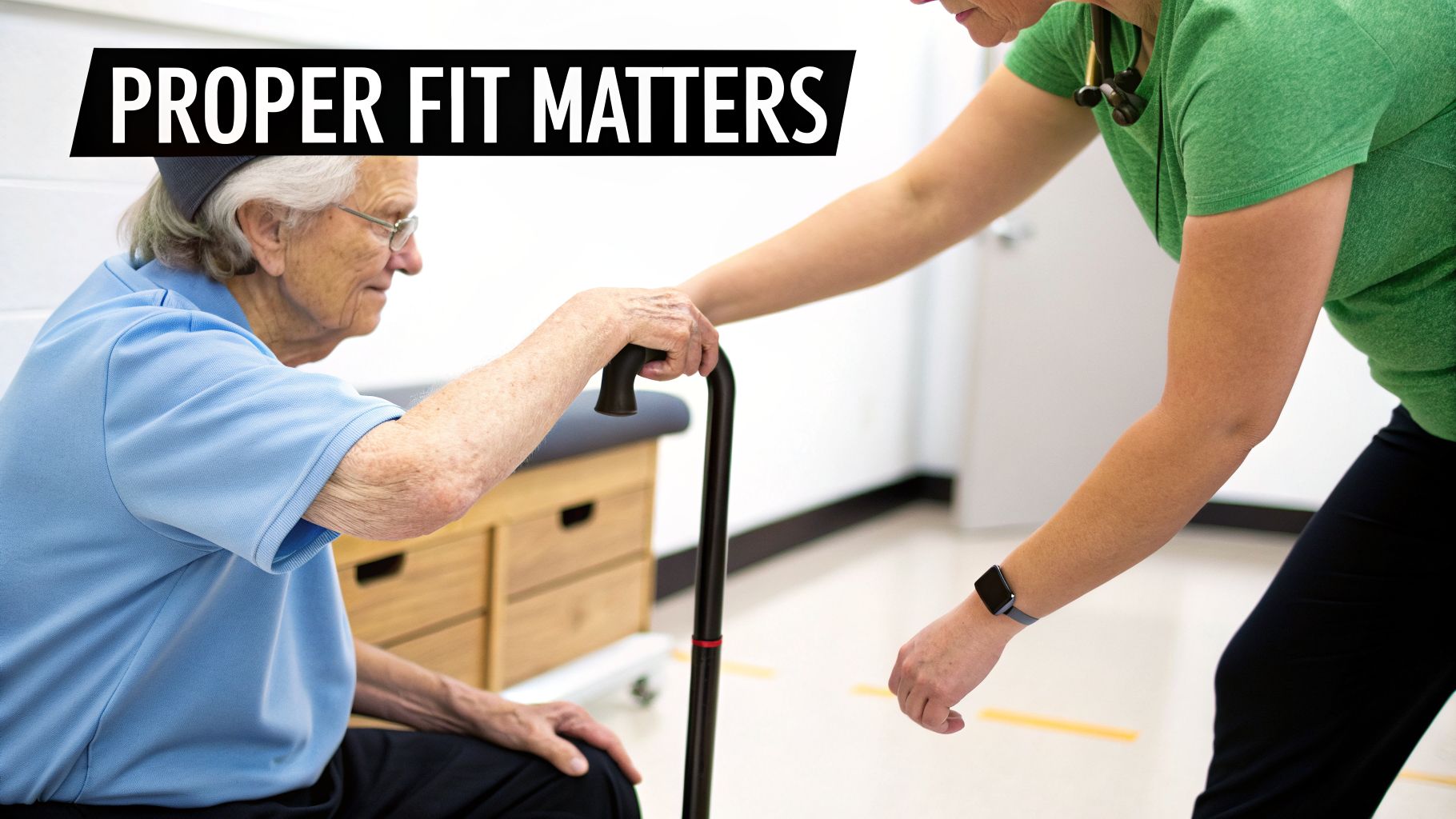
The Elbow Bend Rule: The Gold Standard For Cane Height
So, how do you find that perfect height? Physical therapists and medical professionals rely on a simple but incredibly effective method called the "elbow bend rule."
Here’s how to do it yourself:
- Stand Naturally: First, put on the shoes you walk in most days. Stand up as straight as you comfortably can, letting your arms hang relaxed at your sides.
- Position The Cane: Place the cane, tip-down, next to your foot. You’ll typically hold the cane on the side opposite your weaker or injured leg.
- Check The Wrist Crease: The very top of the cane's handle should line up with the crease on the inside of your wrist. This is your key landmark.
- Confirm The Elbow Bend: Now, place your hand on the grip. Your elbow should have a slight, natural bend to it—right around 15 to 20 degrees.
That gentle bend is the sweet spot. It allows you to press down and get the support you need without having to lock your arm straight or hike your shoulder up to your ear.
The Dangers Of A Poorly Sized Cane
An incorrect cane height isn't just a small annoyance; it's a real safety risk that can cause more problems than it solves.
- If your cane is too tall: You'll be forced to lift your shoulder with every step. Over time, this causes major strain on your shoulder, elbow, and wrist. It feels awkward because it is awkward, and it can seriously compromise your balance.
- If your cane is too short: You'll find yourself hunching over just to reach the handle. This stooped posture is terrible for your back, neck, and shoulders. It also shifts your center of gravity forward, making you less stable.
An improperly sized cane doesn't just fail to provide support; it actively works against your body's natural alignment. The goal is to walk taller and more confidently, not to trade one problem for a new set of aches and pains.
The Value Of A Professional Fitting
While these steps can get you very close at home, nothing beats a hands-on fitting with an expert. A trained professional can watch you walk, observe your unique gait, and make the small adjustments that make a huge difference in comfort and safety.
At Affinity Home Medical Equipment, we take this personalized service seriously. To keep things simple and fast for you, we do not take insurance. This allows us to offer clear, upfront pricing and focus 100% on getting you what you need without waiting for approvals. If you have any questions about getting the right fit, please don't hesitate to ask. You can find all our information on our contact page. We want to make sure you leave with a cane that feels like it was custom-made for you.
Mastering Safe And Effective Cane Walking Techniques
Getting a cane that fits you perfectly is the first big step, but the real magic happens when you learn how to use it properly. It might feel a little strange at first, but with a bit of practice, these movements will become as natural as breathing. Think of this as your personal guide to walking confidently and safely with your new cane.
The single most important rule to remember is this: the cane always goes in the hand on the opposite side of your weaker or injured leg. So, if your left leg is giving you trouble, you'll hold the cane in your right hand. This simple adjustment creates a wider, more stable base of support—your two feet plus the cane—that mimics a natural walking gait and keeps you balanced.
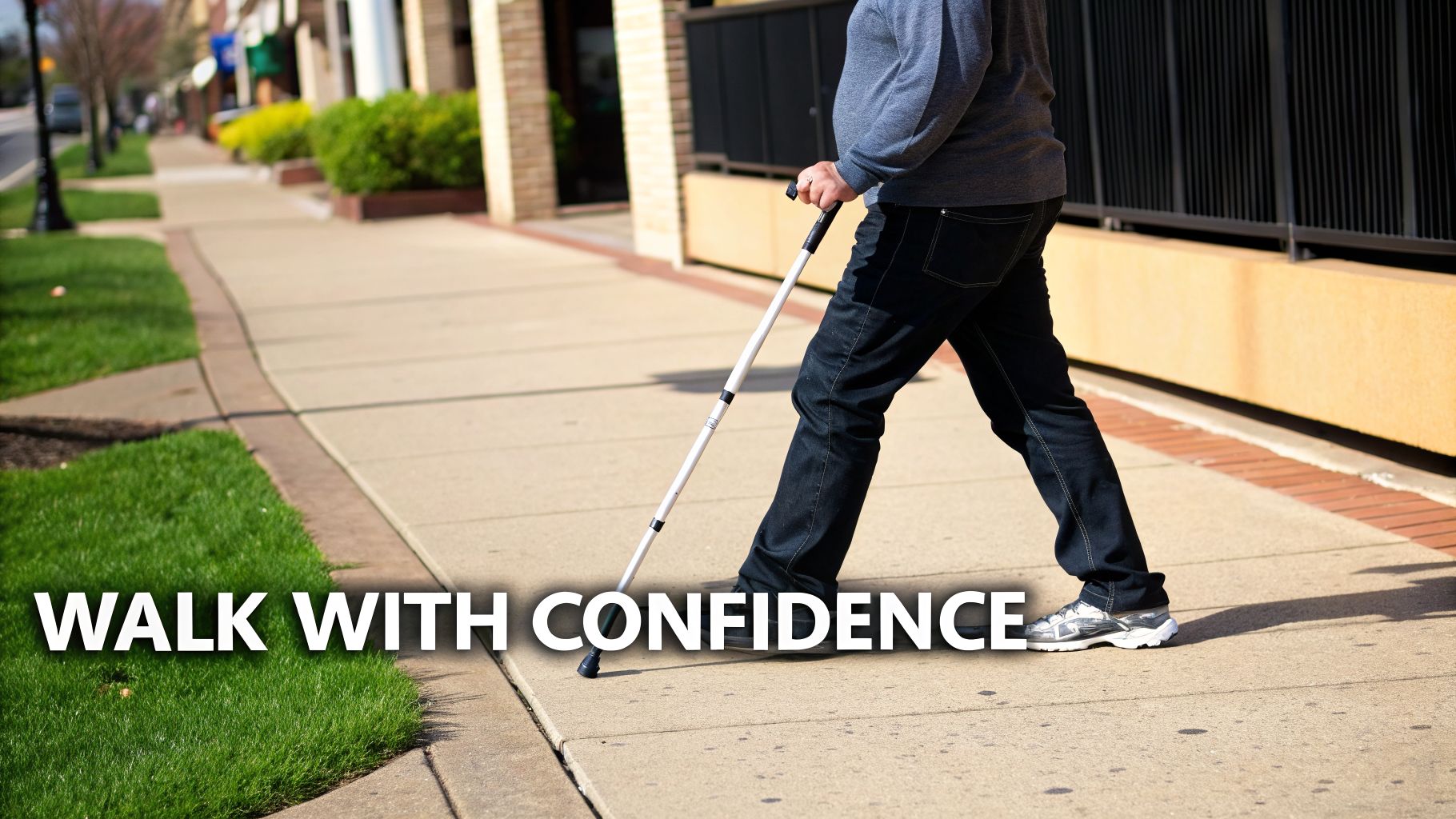
The Basic Walking Rhythm
Imagine your cane and your weaker leg are dance partners—they always move together. This simple coordination is the core of walking safely.
Here’s the simple two-step rhythm to follow:
- Move your cane and your weaker leg forward at the same time.
- Then, step through with your stronger leg, bringing it past the cane.
That’s all there is to it. By moving the cane along with your weaker leg, you give that side support right when it needs it the most. This easy rhythm helps spread your weight evenly and maintains your balance with every step. Try to keep your posture upright and your eyes looking ahead, not down at your feet.
Navigating Stairs With Confidence
Stairs can look like a mountain, but a simple saying makes them much easier to climb: "up with the good, down with the bad." This little phrase is your secret weapon for conquering any staircase.
Going Up Stairs:
- Lead with your stronger, or "good," leg, placing it on the first step.
- Next, bring your weaker, or "bad," leg and your cane up to meet it on that same step.
- Repeat this pattern all the way up, always leading with your good leg.
Going Down Stairs:
- Start by placing your cane on the step below you.
- Now, move your weaker, or "bad," leg down to that step.
- Finally, bring your stronger, or "good," leg down to join them.
Whenever possible, use a handrail. Holding the rail with one hand and your cane with the other gives you the absolute best stability.
Mastering stairs is a huge confidence booster. Taking it one step at a time with the 'up with the good, down with the bad' method transforms a major obstacle into a manageable task.
Tackling Everyday Obstacles
Life isn't just a series of flat hallways. You’ll have to deal with chairs, uneven ground, and all sorts of different floor surfaces.
Getting In and Out of a Chair:
- To sit down: Back up to the chair until your legs are touching it. You can set your cane aside or hook it on the chair’s arm. Reach back with both hands for the armrests and gently lower yourself down.
- To stand up: Scoot yourself to the edge of the seat. Grab your cane with one hand and use the other to push up from the armrest. Once you feel steady on your feet, you're ready to start walking.
Walking on Tricky Surfaces:
Pay close attention when you're on plush carpet, wet floors, grass, or cracked sidewalks. Just slow your pace and make sure the cane's tip is firmly planted before you shift your weight onto it. This is where a high-quality, non-slip rubber tip really proves its worth—it's your best friend for preventing slips.
At Affinity Home Medical Equipment, we believe in providing clear, direct assistance. Because we do not take insurance, we can offer straightforward pricing and immediate service without the usual paperwork headaches. Our only mission is to get you the right mobility solution, right when you need it. To learn even more, feel free to explore the helpful articles on our medical equipment news and blog.
Your St. Petersburg Partner For Medical Mobility
Choosing a medical cane is a big step, but finding a local team that genuinely understands what you’re going through is just as important. For over 20 years, Affinity Home Medical Equipment has been a fixture in the St. Petersburg and Pinellas County community. We’re not just a store; we’re your neighbors, dedicated to helping you get back on your feet with confidence.
When you walk through our doors, you get a level of hands-on, personal service that you just can't find online. Our team is here to guide you through the entire process—from figuring out which type of cane is best to making sure you leave with a device that feels like a natural extension of yourself.
Why Choose A Local Expert?
The process of picking out a mobility aid should feel supportive, not stressful. At Affinity Home Medical Equipment, we put your safety and comfort first with a practical, hands-on approach.
Here’s what that looks like for you:
- Professional, In-Person Fittings: Our experienced staff will personally fit your cane, using the tried-and-true "elbow bend rule" to adjust it to the perfect height for your body and walking style.
- Try Before You Buy: You can actually hold different canes, feel the various grips, and test out different models to see which one gives you the most stability and confidence.
- Same-Day Pickup: If you need support right away, you can get it. For anything we have in stock, you can take it home the very same day—no waiting for a box to show up on your doorstep.
- Flexible Rental Options: Only need a cane for a short time while recovering from surgery? We’ve got you covered with convenient daily, weekly, and monthly rentals.
Straightforward Support Without The Hassle
We believe getting the right mobility aid should be simple. That’s why we do not take insurance. This decision allows us to offer clear, direct pricing and skip the complicated paperwork and long delays that can sometimes occur. Our only focus is on getting you the best possible solution, exactly when you need it.
This direct-to-consumer approach meets a growing need. The walking canes market is surprisingly regional, and as of 2023, North America holds a massive 35% revenue share thanks to high healthcare spending and an aging population. If you're curious about these trends, you can explore public reports on market research sites. Understanding this bigger picture helps us better serve our neighbors right here in St. Petersburg.
Of course, finding the right cane is just one piece of the puzzle. Managing all the related healthcare costs is another. For our local customers, this guide on Health Insurance St Petersburg is a great resource for navigating your options. Think of us at Affinity as your trusted partner, here to provide clear guidance and quality equipment for your journey to better mobility.
Common Questions About Medical Walking Canes
When you start looking into walking canes, it’s completely normal to have a few questions. The more you know, the more confident you'll feel about choosing the right one and using it safely. We've put together some of the questions we hear most often to give you clear, honest answers.
Do I Need A Prescription For A Walking Cane?
This is probably the number one question we get asked. For the most part, you do not need a prescription to buy a standard walking cane. You can walk into our shop today and get one if you feel it will help your balance and stability. They're considered over-the-counter mobility aids.
Since we don’t work with insurance companies, you won’t need a prescription to buy or rent a cane from us. Our priority is getting you the support you need, when you need it.
Getting the right support shouldn't be complicated. While a doctor's advice is always a good idea for your overall health, you don't have to wait on a prescription to improve your stability with a cane.
How Do I Know It's Time To Start Using A Cane?
Making the decision to use a cane is a personal one, but your body often sends some pretty clear signals that it's time. If any of these sound familiar, a cane might be a great help.
- You feel unsteady on your feet. Do you find yourself reaching for walls or the back of a chair to steady yourself as you walk? A cane gives you a reliable third point of contact.
- You're dealing with persistent pain. Walking with a sore hip, knee, or ankle is exhausting. A cane helps take some of the weight off that painful joint, which can make a world of difference.
- You're worried about falling. If the fear of falling is making you less active, a cane can be a huge confidence booster. It helps you stay independent and involved in the things you love to do.
Does Insurance Cover The Cost Of A Cane?
At Affinity Home Medical Equipment, we keep things simple: we do not take insurance. This means we can offer you clear, upfront pricing without any of the paperwork, delays, or surprises that can come with trying to file a claim. Our whole focus is on getting you the right equipment, right away, without the runaround.
If you have other questions about our equipment or how we work, we’ve answered a lot of them on our Frequently Asked Questions page. We're always here to help you figure out the best solution for your needs.
Share This Article

Written by : lori@netcodesign.com
Follow Us
Latest Articles

October 13, 2026

October 13, 2026

October 13, 2026
