
Choosing A Mobility Scooter For Seniors A Practical Guide

A mobility scooter is so much more than a piece [...]
A mobility scooter is so much more than a piece of equipment; it's your ticket to getting back out there and living life on your own terms. This guide is here to walk you through everything you need to know, from the different kinds of scooters to the little details that matter most. We'll help you find the perfect fit for staying active and engaged right here in Pinellas County.
Rediscovering Your Independence With The Right Scooter
Picture this: joining the family for a sunset stroll along the St. Pete Pier or popping over to the shops in downtown Clearwater whenever you please. For many, mobility challenges can start to feel like a wall between you and these simple, everyday joys. The right mobility scooter can tear down that wall, getting you back to the places and people you love.
We want you to see a scooter not just as a machine, but as a genuine tool for a more self-reliant and vibrant lifestyle. Think of us as your local guide. We'll break down the options, explain the features, and help you make a choice with total confidence.
Why Mobility Matters
That desire to do things for yourself doesn't fade with age. In fact, for seniors, it's a huge part of staying happy and healthy. The freedom to get around directly impacts how often we see friends, our mental outlook, and our overall quality of life. And it's not just a feeling; the numbers show a massive need for these solutions.
The global market for mobility scooters is a lifeline for so many, currently valued at USD 1.59 billion and expected to more than double to USD 3.43 billion by 2034. This isn't surprising when you consider that a staggering 40% of U.S. adults aged 65 and older—that's over 20 million people—have a mobility issue that makes walking or climbing stairs tough. You can learn more about the global trends in the mobility scooter market.
Finding A Solution That Fits
Choosing a mobility aid is a deeply personal decision. It all comes down to your specific needs and how you want to live your life. While we're focusing on scooters here, it's good to know what else is out there.
Think of it this way: a mobility scooter is often the perfect choice for someone who can still walk a bit and has the hand and arm strength to steer. For others with different support needs, another type of device might be a better fit.
Our goal is simple: to help you find the solution that gives you back your freedom and works for your unique situation. Whether you're looking for yourself or a loved one, just understanding the differences is the best place to start. If you're also weighing other options, you might find our guide on wheelchairs in St. Petersburg, FL helpful.
Finding Your Perfect Fit: Understanding the Different Types of Scooters
Choosing the right mobility scooter isn't about getting bogged down in technical jargon. It’s really about matching the scooter's design to your everyday life. Think of it like picking a car—you wouldn't take a compact sedan on a rugged camping trip, and the same practical logic applies here.
Let's walk through the three main styles of mobility scooters. Each one is built for a specific purpose and environment, ensuring there’s a perfect match for every lifestyle, from navigating your home to exploring the beautiful parks around Pinellas County.
The Nimble Navigator: 3-Wheel Scooters
Picture a sleek sedan easily maneuvering through a crowded mall parking lot. That’s the feeling you get with a 3-wheel mobility scooter. Its single front wheel is the secret to its agility, giving it a much tighter turning radius that’s perfect for indoor navigation.
This maneuverability is its superpower. A 3-wheel scooter is an ideal companion for navigating through doorways, winding down hallways, and getting around furniture at home. It truly shines in places where space is at a premium, like a busy grocery store aisle or a doctor's office.
- Best For: Mainly indoor use or on smooth, paved surfaces.
- Key Advantage: Unbeatable maneuverability with a very tight turning radius.
- Primary Limitation: Not as stable on bumpy or uneven outdoor ground compared to 4-wheel models.
If most of your day is spent indoors or running errands at local shops, the easy handling of a 3-wheel model is hard to beat.
The Sturdy Explorer: 4-Wheel Scooters
Now, think of a sturdy SUV. It’s built to feel solid and secure, ready to handle all sorts of road conditions with total confidence. That’s the perfect way to describe a 4-wheel mobility scooter—the most stable option you can find.
With two wheels up front and two in the back, its wide base gives you a solid, planted feel on the ground. This makes it the go-to choice for outdoor adventures, whether you’re crossing a grassy park, rolling down a bumpy sidewalk, or navigating a gravel path. They have a wider turning radius, but what you trade in nimbleness you gain in peace of mind on uneven terrain.
- Best For: Outdoor use and tackling different types of terrain.
- Key Advantage: Maximum stability for a secure, confident ride.
- Primary Limitation: The larger turning radius makes it less suited for tight indoor spaces.
For anyone who loves spending time outside or lives in an area where the sidewalks aren't perfectly smooth, the 4-wheel scooter is a dependable workhorse.

Ultimately, the goal is to find a tool that empowers you. The right scooter is more than just a machine; it’s a key to staying active, engaged, and independent.
The Go-Anywhere Companion: Travel & Folding Scooters
Finally, imagine the convenience of a compact, carry-on suitcase. It’s light, simple, and designed to go wherever you do. This is exactly the idea behind travel and folding mobility scooters, which are engineered for ultimate portability.
These scooters are a lifesaver for active seniors and their families. They either fold down into a compact shape or disassemble into a few lightweight pieces, making them a breeze to pop into a car trunk. This means you can easily bring your mobility with you on family vacations, day trips, or simple outings.
Their lightweight design often means they have a slightly lower weight capacity and a shorter battery range than their bigger cousins. But for those who value convenience and transportability above all else, they are an absolutely brilliant solution.
Ready to see these different styles for yourself? You can browse our full selection of mobility scooters online to get a better feel for which one fits your life.
Essential Features To Match Your Lifestyle
Once you've got a handle on the type of scooter you need, the real fun begins. Now we get to dig into the specific features that will make your day-to-day life not just manageable, but genuinely easier and more comfortable. This isn't about getting lost in a bunch of technical jargon; it's about matching the scooter's real-world abilities to your real-world needs.
Think of it like getting a custom-fitted chair—the right dimensions and support make all the difference. We’re going to look at four key areas that directly affect your comfort, safety, and freedom. Getting these right is how you find a scooter that feels less like a machine and more like a trusted partner.
Checking The Weight Capacity
First things first, let's talk weight capacity. This is the absolute maximum weight the scooter is built to safely handle, and it's a non-negotiable safety spec. You absolutely need a model that can support your body weight plus anything you plan on carrying with you.
Think about your daily trips. Are you just bringing a small purse, or will you be loading up on groceries? Do you need to carry a portable oxygen tank? All of that adds up. Pushing a scooter past its weight limit is a bad idea—it strains the motor, drains the battery faster, and can even make the scooter unstable.
A great rule of thumb is to pick a scooter with a weight capacity at least 25 to 50 pounds higher than your own weight. This gives you a safe buffer for carrying your belongings and ensures the scooter runs smoothly without being overworked.
Understanding Battery Range
Next up is how far your scooter can actually take you on a single charge. This is called the battery range. You’ll see a pretty wide spread here, with some models designed for about 8-10 miles and others that can go 20 miles or more.
The right choice comes down to how you picture yourself using it.
- Short Trips: If your main goal is zipping down to the corner store, getting around your home and yard, or making quick trips to the pharmacy, a standard range of 8-12 miles is probably all you'll ever need.
- Full-Day Outings: But if you're dreaming of bigger adventures—like spending a whole day at the St. Pete Pier, exploring Sunken Gardens, or tackling a big shopping trip at Tyrone Square Mall—you'll want the peace of mind that comes with a long-range model.
There’s nothing worse than having to cut a great day short because you're worried about your battery dying. Matching the range to your ambitions is the key to real independence.
Mastering The Turning Radius
The turning radius sounds technical, but it’s actually a really simple idea that has a huge impact on your daily life. It’s the smallest amount of space the scooter needs to make a U-turn. A smaller, or "tighter," turning radius means the scooter is more nimble and way easier to handle in tight spots.
This is where you really see the difference between indoor and outdoor models.
- A 3-wheel scooter is the champion of tight spaces. Its sharp turning radius is perfect for navigating narrow hallways, swinging around kitchen counters, and weaving through crowded store aisles.
- A 4-wheel scooter needs more room to turn. It’s less agile inside but feels right at home in wide-open spaces where that rock-solid stability is more important than making hairpin turns.
If you need help getting around those smaller indoor spaces but want a 4-wheel scooter for outdoor adventures, you might want to look at other options for inside the house. For those situations, we have a great selection of walkers and rollators available in St. Petersburg, FL.
Prioritizing Seat Comfort
Last but certainly not least, never, ever underestimate the power of a good seat. If you plan on being in your scooter for more than a few minutes here and there, the seat becomes one of the most important features for your comfort and health. A bad seat can cause back pain and fatigue, making you not want to use your scooter at all.
Look for a few key things that make a big difference. You want a seat with plenty of supportive padding, sturdy armrests you can adjust or flip up, and the ability to swivel. That swivel feature is a game-changer, letting you turn to the side to sit down or get up without twisting your back.
Safety and Accessibility Features You Cannot Ignore
When you're choosing a mobility scooter, you're not just buying a machine; you're investing in freedom and confidence. Whether it’s a quick jaunt to the mailbox or a leisurely ride through downtown St. Pete, the right features can make all the difference, turning a good scooter into a trusted companion. Let's talk about the non-negotiables that provide real peace of mind.
These features aren't just nice-to-haves; they're essential. Worldwide, an incredible 45% of people aged 60 and older—that’s over 336 million people as of 2021—live with a disability. More than 245 million of them face mobility challenges that make aids like scooters a part of daily life. For families and caregivers, knowing a scooter is built to prevent falls is priceless. You can learn more about trends in personal mobility devices to see how important this technology has become.
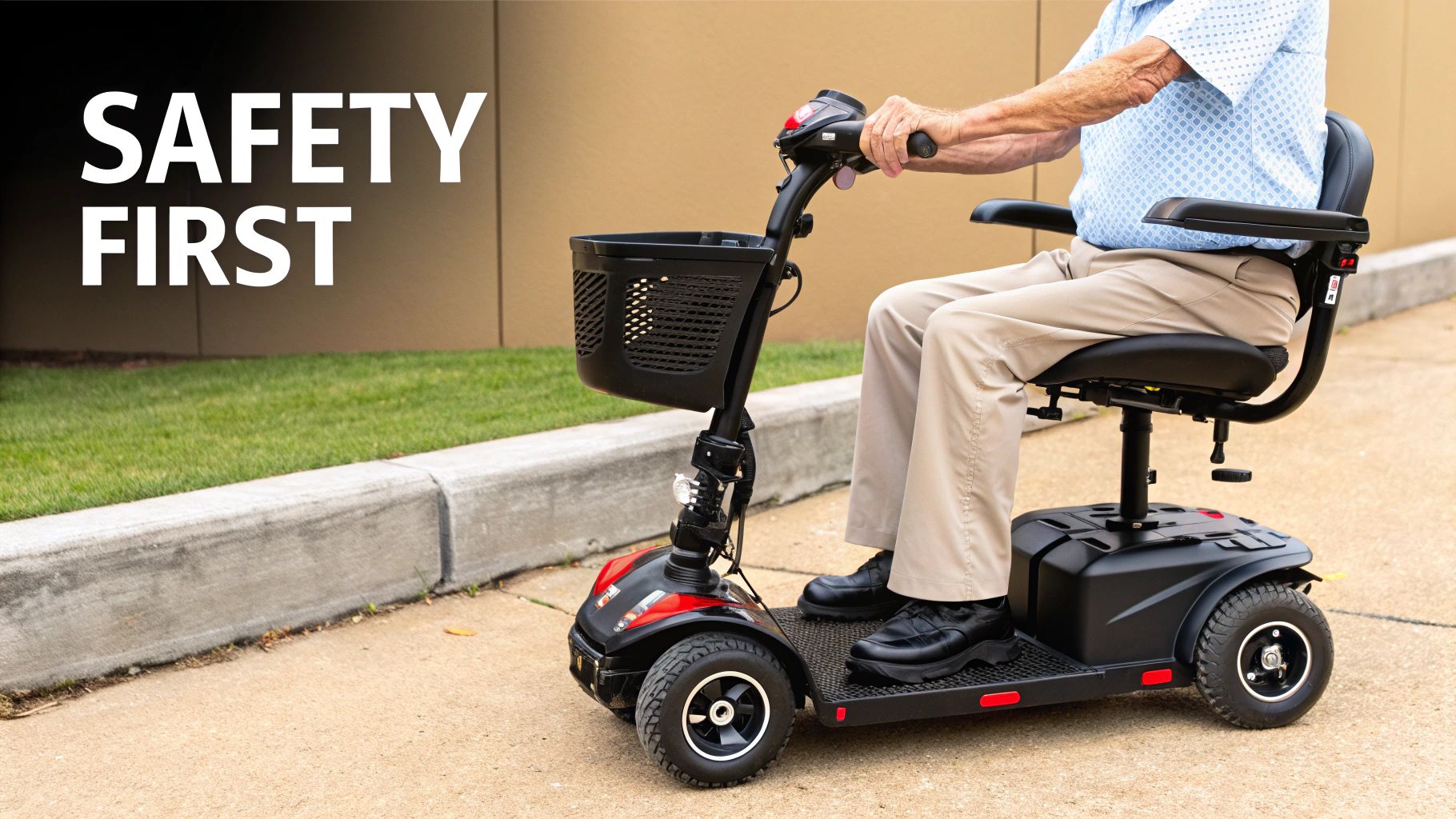
Building a Foundation of Stability
A stable scooter feels solid and secure under you, especially when you encounter a small curb, a grassy patch, or a ramp. It's that feeling of being planted on the ground, and a few key components work together to create that secure ride.
- Anti-Tip Wheels: Think of these as a safety net. They're small, secondary wheels, usually at the back, that prevent the scooter from tipping backward on an incline. You'll never notice them until you need them, and that's exactly how they should work.
- Responsive Braking System: Most modern scooters feature automatic electromagnetic brakes. This is a fancy way of saying the scooter stops smoothly and safely the moment you let go of the throttle. No fumbling for a brake lever—it's intuitive and incredibly reliable.
Enhancing Daily Comfort and Ease of Use
Safety is also about how the scooter fits you. A machine that causes you to strain or sit uncomfortably isn't a good long-term solution. The goal is to find a scooter that feels like a natural extension of yourself.
The best accessibility features are the ones you barely notice because they make every interaction with your scooter feel natural and effortless. From getting on and off to reaching the controls, every detail should be designed with your comfort in mind.
Here are a couple of features that make a huge difference in day-to-day use:
- Swivel Seat: This is a game-changer. A seat that rotates allows you to turn to the side, sit down comfortably, and then swing yourself forward to face the controls. It completely eliminates the awkward shuffle of trying to get on or off from behind the steering column.
- Adjustable Tiller: The tiller is the steering column. Being able to adjust it—pulling it closer or pushing it farther away—lets you find the perfect arm position. This prevents slouching and reduces strain on your shoulders and back during longer rides.
Ensuring Visibility and Convenience
Finally, let's talk about the practical stuff that makes every trip safer and easier. Being seen by others is just as important as seeing where you're going, especially if you're out and about in the early morning or evening.
Look for a scooter with bright, energy-efficient LED headlights and taillights. They cut through the dim light and make you highly visible to drivers and pedestrians. And don't underestimate the simple utility of a front-mounted basket! It gives you a secure spot for groceries, a purse, or other personal items, freeing up your hands to focus on steering and enjoying the ride.
Our Approach To Payment And Insurance
Understanding the cost and payment process is a crucial step in getting the right mobility scooter for seniors. Many people wonder about insurance coverage, and it's important to have a clear picture of how it works.
At Affinity Home Medical Equipment, we prioritize a straightforward and efficient process to get you the mobility solution you need without unnecessary delays. To achieve this, we have a direct-payment policy.
Why We Don't Accept Insurance Directly
The insurance approval process for mobility scooters can often be slow, complicated, and filled with uncertainty. Dealing with paperwork, waiting for approvals, and facing potential denials can be a frustrating experience, especially when you need a solution now.
To better serve our Pinellas County community, we've chosen not to bill or accept insurance directly, including Medicare and Medicaid. This allows us to cut through the red tape and offer you clear, upfront pricing. You know the exact cost from the start and can often take your scooter home the very same day.
Our goal is to put you back in control. Our direct-payment approach means no waiting, no complicated forms, and no uncertainty. You get the scooter you need, right when you need it.
Your Options For Insurance Reimbursement
Just because we don't bill insurance directly doesn't mean you can't seek reimbursement on your own. If you believe your insurance plan may cover a portion of the cost, we are here to support you in that process.
Here's how we help:
- You purchase the scooter directly from us. This is a simple, transparent transaction.
- We provide you with a detailed receipt. This isn't just a standard receipt; it's an itemized document with all the specific codes and information that insurance companies require for claims.
- You submit the claim to your provider. You can then send this paperwork directly to your insurance company to request reimbursement according to the terms of your policy.
This system empowers you. It provides the speed and convenience of a direct purchase while still giving you the necessary tools to navigate the insurance process on your own terms.
Deciding To Purchase Or Rent Your Scooter
So, should you buy a mobility scooter or just rent one? It's one of the first big questions people ask, and honestly, there’s no one-size-fits-all answer. The right move really boils down to your personal situation and how long you'll need the scooter. It's a bit like deciding whether to lease a car for a few months or buy it for the long haul.
Buying a scooter is a fantastic investment if you're looking for a permanent mobility solution. If you know you'll be using it daily—for trips to the grocery store, visiting friends, or just getting around your neighborhood—then ownership makes the most sense. It’s yours, always charged and ready to go whenever you are.
Renting, on the other hand, is all about flexibility for shorter-term needs. It’s the perfect answer for a whole host of temporary situations.
When Renting Makes Perfect Sense
Renting is a lifesaver when buying a scooter just doesn't make financial or practical sense. You get all the benefits of a top-notch machine without the commitment of ownership.
Here are a few classic examples where renting is the way to go:
- Post-Procedure Recovery: If you're healing from a surgery, a rental scooter can give you your freedom back during the recovery period without a big upfront expense.
- Visiting Family: Have relatives with mobility issues coming to town? Rent a scooter so they can join you for a stroll along St. Pete Pier or a trip to the Sunken Gardens.
- A Trial Period: Maybe you're on the fence about which model feels right. Renting lets you "try before you buy," so you can get a real feel for a scooter before making a final decision.
Renting is a practical, low-commitment way to solve an immediate mobility challenge. It bridges the gap, offering independence exactly when and for how long you need it.
If a temporary solution sounds right for you, take a look at our flexible plans for St. Petersburg medical equipment rentals—we can set you up for a few days, a week, or longer.
Common Questions About Mobility Scooters
We've found that having all the facts makes choosing a scooter a much more confident and comfortable experience. To help you cross that finish line, here are some straightforward answers to the most common questions we hear from families right here in Pinellas County.
Do I Need A Prescription For A Mobility Scooter?
Generally, no. You don't need a prescription to buy or rent a scooter from a retailer like us.
However, if you're hoping to get reimbursement from your insurance company, they will absolutely require a doctor's prescription. It needs to state that the scooter is a medical necessity for you to use inside your home.
Will A Mobility Scooter Fit In My Car?
That’s a big one, and it really comes down to two things: the scooter model and your vehicle.
- Standard Scooters: Your larger, more substantial 4-wheel scooters almost always need a special vehicle lift or a ramp to get them transported.
- Travel and Folding Scooters: This is where portability shines. These are designed to break down into a few manageable pieces or fold up neatly, making them a great fit for most car trunks.
Before you decide, it’s always a smart move to measure your trunk space. Just to be sure.
How Far Can A Scooter Go On A Single Charge?
The range really varies from scooter to scooter. Think of it like a car's gas mileage—it depends on the battery size, the rider's weight, and even the terrain. Driving up hills will use more juice than cruising on a flat, smooth sidewalk.
On a full charge, most scooters will get you somewhere between 8 to 20 miles. The trick is to be honest about how you'll use it. If you're just zipping around the neighborhood, a shorter range might be perfect. But for all-day adventures at the pier or a local festival, you'll want that longer range so you're not constantly worried about the battery.
Your scooter's range is its lifeline to freedom. Matching it to your lifestyle ensures you’ll never have to cut a wonderful day short because you're concerned about getting home.
What’s The Difference Between A Scooter And A Power Wheelchair?
This is a really important distinction, as they're built for different needs. A mobility scooter is a fantastic tool for someone who can still walk a bit, has decent upper body strength, and can comfortably operate the tiller steering system.
On the other hand, power wheelchairs are typically the better choice for people with more significant mobility challenges. They are designed for individuals who need full-time support, both inside and out, and might require more specialized seating or control systems, like a joystick. We dive into more topics like this all the time; for instance, you can find answers to more of your questions by visiting our detailed FAQ page.
Ready to rediscover your independence with the perfect mobility solution? The team at Affinity Home Medical Equipment has been proudly serving the Pinellas County community for over 20 years. Visit us in St. Petersburg for personalized guidance, same-day pickup on in-stock items, or to learn about our flexible rental options. Find your freedom today at https://affinityhomemedicalequipment.com.
Share This Article

Written by : Rich affinityrich@gmail.com
Follow Us
Latest Articles

October 14, 2026

October 14, 2026

October 14, 2026
