
Mobility Scooter Vs Power Wheelchair: A 2026 Comparison Guide

When people start looking into mobility aids, the first question [...]
When people start looking into mobility aids, the first question is almost always the same: "Should I get a scooter or a power wheelchair?" The answer really comes down to a single, simple idea. Mobility scooters are for people who can still get around on their own but need a hand with longer distances, while power wheelchairs are built for those who need consistent mobility support throughout their day, especially indoors.
It's about choosing between part-time help for outings and full-time support for daily life.
Choosing Your Path To Independence In St. Petersburg
Making the right choice between a mobility scooter and a power wheelchair is personal. It's about matching the equipment to your specific lifestyle here in Pinellas County. From a trip to the grocery store to a beautiful afternoon at Vinoy Park, what you need can vary greatly.
Think of it this way: a mobility scooter is a great companion for someone who can walk around their home without issue but gets tired or feels unstable during longer excursions. A power wheelchair, on the other hand, becomes an essential extension of a person, providing mobility for nearly every task, both inside the house and out.
Key Functional Differences
To really understand which is right for you, you have to look at how they're designed and controlled. Their core mechanics are built for very different needs and environments.
- How You Drive: Scooters use a tiller, which is a lot like the handlebars on a bike or moped. You need both hands and a good amount of upper body strength and coordination to steer. A power chair uses a simple joystick that can be controlled with just a few fingers, requiring very little strength or dexterity.
- Where You'll Use It: Scooters are fantastic outdoors on sidewalks and other paved surfaces. But for getting around inside a home, a power wheelchair is the clear winner. Its much smaller turning radius makes navigating tight hallways, doorways, and corners a breeze.
Now, let's talk about one of the most practical parts of this decision: cost. It's important for you to know that here at Affinity, we do not work with insurance. We keep things simple with clear, upfront pricing on all sales and rentals. This way, you can make a decision based on your needs and budget without navigating insurance complexities. You can see everything we offer by exploring our home medical equipment solutions.
To put the most important differences side-by-side, here is a quick overview.
Quick Comparison: Mobility Scooter Vs. Power Wheelchair
This section breaks down the key differences in how these devices are used, how they move, and who they are best suited for.
Feature: Best Use Case
- Mobility Scooter: Part-time use, outdoor travel, and for users with good trunk control.
- Power Wheelchair: Full-time use, indoor maneuverability, and for users needing postural support.
Feature: Turning Radius
- Mobility Scooter: Larger (approx. 35-55 inches), making it less ideal for tight indoor spaces.
- Power Wheelchair: Much tighter (approx. 20-25 inches), perfect for navigating home interiors.
Feature: Seating & Support
- Mobility Scooter: Standard, comfortable captain's-style seats with limited adjustments.
- Power Wheelchair: Highly customizable seating for complex medical and positioning needs.
Looking at this, you can see the choice is less about which one is "better" and more about which one is built for your world—whether that's the wide-open paths of a park or the familiar corners of your own home.
Comparing How Each Device Fits Your Daily Life
Choosing between a mobility scooter and a power wheelchair isn't about which one has a longer feature list. It's about figuring out which device will genuinely fit into your day-to-day life. The right choice is the one that works with your routines, your home, and your physical needs without adding frustration. How it handles indoors versus outdoors, the kind of support the seat offers, and how you’ll get it from place to place will make all the difference for your independence.
To get you started, this chart breaks down the fundamental choice you're facing.

As you can see, the first question is always about need. Are you looking for a boost to get through a long day on your feet, or do you need consistent support for most of your daily activities? Answering that question is the first step in deciding between a scooter and a power chair.
Indoor Agility Versus Outdoor Freedom
The biggest practical difference between these two devices comes down to their turning radius. This single factor determines where they truly shine. A mobility scooter’s design, with its longer base and handlebar-style tiller, gives it a much wider turning circle, usually somewhere between 35 to 55 inches.
This makes scooters perfect for wide-open areas. Think about gliding along the St. Pete pier, easily navigating the broad aisles at Publix, or spending a beautiful afternoon at Vinoy Park. They are built for stability and comfort on sidewalks and other paved outdoor surfaces.
On the other hand, a power wheelchair is built for incredible precision. Most models, especially the popular mid-wheel drive designs, have a zero-turn radius. They can literally pivot in place, needing only 20 to 25 inches of space.
Key Insight: A power wheelchair’s ability to turn on a dime isn’t just a nice-to-have feature; it’s what makes it a practical, full-time mobility tool for inside the home. It can handle tight corners in the kitchen, narrow hallways, and standard doorways that would stop a scooter in its tracks.
Seating Comfort And Medical Support
The seats on these devices tell you a lot about who they're designed for. Mobility scooters typically come with what's called a "captain's seat."
This seating is plenty comfortable for general use and usually includes:
- Padded, flip-up armrests that make getting on and off easier.
- A seat that swivels, so you can turn to sit at a table or just stand up more safely.
- Good, basic back support for someone who has solid trunk control.
A power wheelchair is in a completely different league when it comes to seating. Since it's often a medical necessity for people who will spend the majority of their day in the chair, the seating is highly adaptable to meet serious health needs.
These sophisticated seating systems can be customized with options like:
- Power tilt and recline functions to redistribute pressure and improve blood flow.
- Contoured cushions and backrests molded to provide specific postural support.
- Elevating leg rests that help reduce swelling and increase overall comfort.
This is a critical distinction. If you need specialized postural or medical support, a power wheelchair is built from the ground up to provide it. A scooter is built for comfort during shorter periods of activity. If you are leaning towards a device for outdoor adventures, take a look at our guide on St. Petersburg mobility scooters for sale and rent.
Portability, Transport, And Lifestyle Fit
How you plan to transport your device is a massive consideration. Mobility scooters, particularly the travel models, are designed to be portable. Many can be taken apart in seconds, breaking down into a few lighter pieces that you can pop into the trunk of a car.
This makes a scooter a fantastic partner for an active lifestyle. You can easily bring it on vacation, on day trips to visit family, or for a day of shopping. Best of all, it requires no special modifications to your vehicle.
Power wheelchairs are a different story. Their heavy frames, powerful motors, and complex seating systems mean they don't come apart for transport. Getting one from place to place almost always requires a van or other accessible vehicle with a dedicated ramp or lift. This makes them less ideal for spontaneous trips and better suited for someone who needs reliable mobility around their main environments, like home, school, or work.
Market data shows how these different uses play out. In the U.S., wheelchairs captured a large share of the personal mobility market revenue in 2023, and that share is growing faster than any other category. This is largely driven by the increasing number of adults with chronic conditions who rely on the comprehensive, full-time support that only a power wheelchair can offer.
Real-World Scenarios: Who Is Each Device For?

The choice between a mobility scooter vs power wheelchair really comes down to your day-to-day life. Forget the spec sheets for a moment. The best way to decide is to see how these devices fit into real situations. Let's paint a picture of two very different people to show you exactly what we mean.
The Ideal Mobility Scooter User
Think of an active senior living in Seminole or Pinellas Park. They get around their house just fine and are perfectly capable of standing and walking on their own. They have good trunk control and the upper body strength to handle things.
The real problem isn't mobility—it's stamina. A trip to the St. Pete Pier or a long afternoon at the Dali Museum sounds fantastic, but the reality of walking that far is exhausting. It's the long distances that become a barrier, preventing them from fully enjoying all the community has to offer.
A mobility scooter is a game-changer for this person. It’s the perfect tool to reclaim their independence outside the home.
- A Stamina Booster: This isn't for getting from the couch to the kitchen. It’s for getting from the car to the park entrance and then spending hours exploring without getting worn out.
- Supports an Active Lifestyle: They can grab a travel model, break it down, and pop it in the trunk. Suddenly, a spontaneous trip to Treasure Island or lunch in downtown St. Pete is back on the table.
- Requires Some Physical Ability: They need enough strength and dexterity in their hands to operate the tiller steering, which works much like the handlebars on a bicycle.
The key takeaway here is that a scooter is a lifestyle-enhancer. It’s for people who are already mobile but need a boost to conquer longer distances and stay active in their community. It bridges the gap between getting tired easily and needing full-time assistance.
The Ideal Power Wheelchair User
Now, let's shift gears. Imagine someone in Clearwater or Largo who is managing a condition like advanced multiple sclerosis, a spinal cord injury, or severe arthritis. Their ability to move is significantly limited. Walking safely, even for a few steps inside their own home, has become difficult or impossible.
This person needs mobility support around the clock. Their device isn't just for outings; it's an essential part of their life, an extension of their body. Their needs are far more complex and directly tied to their health, comfort, and safety.
For them, a power wheelchair isn't a choice—it's a necessity.
- Essential for Indoor Living: The zero-turn radius on a mid-wheel drive power chair is a lifesaver. It allows them to navigate tight hallways, small bathrooms, and cluttered spaces where a scooter simply couldn't go.
- Provides Critical Medical Support: Their health requires specialized seating. They might need power tilt and recline functions to relieve pressure, custom cushions for postural support, or elevating leg rests to manage swelling. These aren't just comfort features; they're medical necessities.
- Offers Effortless Control: A simple joystick requires very little physical effort. This makes it perfect for someone with limited hand or arm strength, giving them precise control to move through a crowded home or office.
A Note On Cost And Insurance
When you're weighing a mobility scooter vs power wheelchair, the financial side is obviously a big part of the equation. Generally speaking, power wheelchairs cost more upfront. That's because they are more complex machines with advanced motors and highly specific medical seating options. Scooters are simpler by design and usually more affordable.
It's important for you to know that we do not take insurance. We've found this allows us to offer transparent, direct pricing for all our sales and rentals. You avoid the long waits and red tape of insurance claims, empowering you to get the equipment you need, when you need it. Our goal is to give you honest advice and a clear path to a solution.
This direct model means you are in full control. You can explore our wheelchair sales and rental services in St. Petersburg to find what fits your needs and your budget, without any hidden complexities.
Getting Real About Costs, Insurance, And Local Options
Let's talk about the bottom line. The price tag is often the first thing people look at, and it's one of the biggest differentiators between a mobility scooter and a power wheelchair. Understanding what you're paying for is crucial to making a smart investment in your independence.
Power wheelchairs almost always come with a higher initial cost. There's a good reason for that—they are sophisticated medical devices, built from the ground up with complex electronics and highly specialized seating systems designed to address specific health conditions. You're not just buying a chair; you're investing in a piece of clinical-grade equipment.
Mobility scooters, on the other hand, are designed for more straightforward, everyday use. Their simpler T-bar steering and standard seating make them easier to produce, which translates to a more accessible upfront price.
Our Transparent, No-Insurance Approach
We've made a deliberate choice to keep things simple and clear for our customers. That’s why we do not work with insurance providers. By operating as a direct-to-consumer retailer, we can offer you straightforward, transparent pricing on all our sales and rentals.
This direct model puts you in the driver's seat. You get to decide what works for your mobility and your budget, without the headaches, paperwork, and long waits that often come with the insurance approval process. Our focus is on getting you the right equipment, right when you need it.
When Renting Just Makes Sense
Sometimes, a permanent purchase isn't the right move. If your need for a mobility device is temporary, renting is a practical and budget-friendly alternative.
We see people choose our flexible rental programs for all sorts of reasons:
- Recovering from surgery: A rental can be a lifesaver for those few weeks you need extra support getting around the house.
- Having visitors in town: Make sure your family and friends can fully enjoy their St. Petersburg visit by renting a scooter or wheelchair for their stay.
- Trying before you buy: Feeling unsure? Renting is the perfect way to test-drive a device in your real-world environment before committing to a purchase.
With daily, weekly, and monthly options, you have the flexibility you need. If you're looking into short-term mobility solutions, you can find all the details on our St. Petersburg medical equipment rentals page.
The Big Picture: Market Value and User Needs
When you look at the mobility scooter vs power wheelchair market, you see a clear split. The entire power mobility market was worth about $12 billion in 2023 and is expected to climb to $16 billion by 2028. Power wheelchairs make up the lion's share of that value because for many, they aren't just a convenience—they're an essential medical necessity for daily life.
On the other hand, scooters are gaining ground fast. Their popularity is growing at a projected 7.4% annually, mostly because they are affordable, easy to operate, and incredibly useful for maintaining an active, independent lifestyle around town.
The Value of Local, Hands-On Support
Your journey with a mobility device doesn't stop the day you buy it. Just like a car, both scooters and power chairs need regular upkeep to perform safely and reliably. This is where having a local partner you can trust really pays off.
At Affinity, we only carry high-quality, dependable brands that we stand behind. If you ever need a new battery, a tire checked, or any other kind of service, our St. Petersburg team is right here to help. Knowing that expert support is just around the corner provides peace of mind and keeps you moving with minimal downtime.
Your Trusted Mobility Partner in Pinellas County
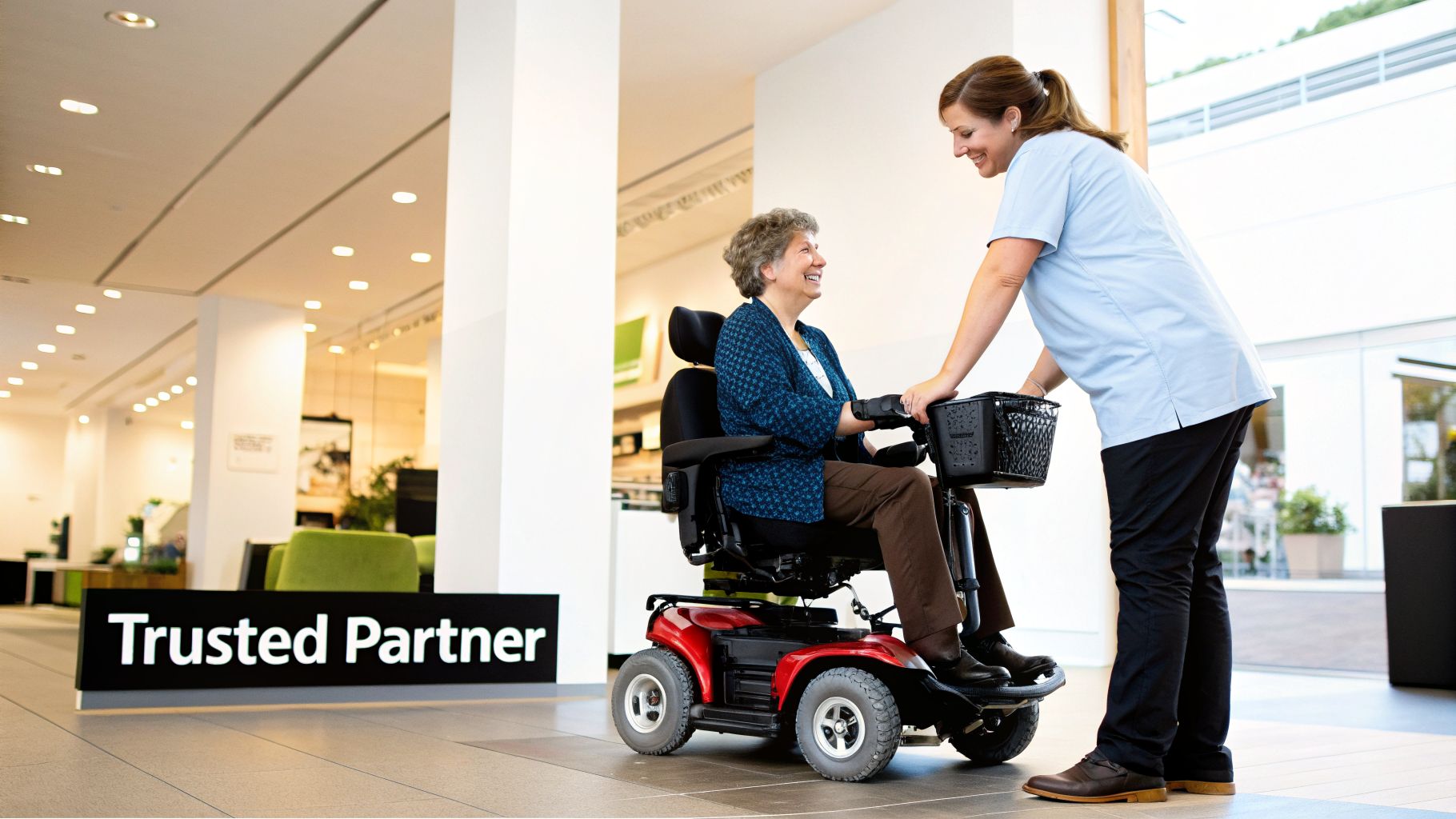
Hopefully, this guide has given you a much clearer picture of whether a mobility scooter vs power wheelchair is the right fit for you. But choosing the right device is just the first step. Having a local, reliable team to back you up makes all the difference in the world.
Let's boil it down one last time. A mobility scooter is often the perfect choice for part-time, mostly outdoor use when you can still walk but need help with longer distances. A power wheelchair, on the other hand, is designed for full-time support, especially for those with complex mobility and positioning needs who require excellent indoor agility.
Making a Confident Purchase Without Insurance
We believe in making the financial side of things as straightforward as possible. That’s why we do not take insurance. By operating this way, we can offer clear, upfront pricing on every sale and rental, so you know exactly what to expect. There’s no wrestling with insurance claims or waiting around for approvals—just honest pricing that helps you make the best choice for your budget.
It’s interesting to see how the wider market reflects these different uses. Power wheelchairs, with their deep clinical applications, captured a significant portion of the powered mobility market revenue. This is because they are essential for so many people with significant mobility impairments. Mobility scooters, valued for their role in outdoor and leisure activities, made up a smaller but growing segment of the market.
For a deeper dive into the purchasing process, you can explore many other comprehensive buyer's guides for durable medical equipment online.
The Advantage of a Local Partner
Working with a local company like Affinity Home Medical Equipment is about more than just a transaction; it's about building a relationship. When you come to our St. Petersburg showroom, you can actually see, touch, and test out the equipment. Our team has been doing this for years, and we can give you practical advice based on your real-world needs. Plus, for anything we have in stock, you can take it home the very same day.
Peace of Mind: Having local support means service, repairs, and expert advice are always just a short drive away. This ensures minimal downtime and keeps you moving safely.
We're here to help you find the right solution. Feel free to call us or stop by the showroom to talk through your options. Find out more about our commitment to the Pinellas County community and let us help you regain your independence.
Frequently Asked Questions
When you start digging into the world of mobility scooters and power wheelchairs, a lot of practical questions pop up. Getting straight answers is key to feeling confident in your choice, especially when it comes to getting around here in the St. Petersburg area.
Can I Use A Mobility Device On Pinellas County Public Transit?
Absolutely. The Pinellas Suncoast Transit Authority (PSTA) is set up to accommodate both mobility scooters and power wheelchairs. The main things to keep in mind are size and weight restrictions. Your device also needs to be secured safely on the bus. It's always a smart move to check the latest PSTA guidelines online before you plan your first trip, just to be sure your specific model will work without a hitch.
Should I Choose A 3-Wheel Or 4-Wheel Mobility Scooter?
This is a great question, and it really comes down to a trade-off between agility and stability. A 3-wheel scooter has a much tighter turning radius, which is a huge advantage when you're navigating tight grocery store aisles or crowded spaces. On the other hand, a 4-wheel scooter has a wider, more stable base. That extra stability feels great when you’re traveling over uneven sidewalks, grassy areas, or gentle slopes.
What Is The Typical Battery Range I Can Expect?
Battery life can vary quite a bit depending on the specific model, the terrain you’re on, and the rider's weight. As a general rule, most mobility scooters will give you a range of 8 to 20 miles from a full charge. Power wheelchairs, which are often built for all-day use and have bigger batteries, usually fall within a 10 to 20-mile range, though some high-end models can go even further.
It's important to remember that these are just estimates. Things like frequent stops and starts, climbing hills, and even the outdoor temperature can impact how far you can go. We can help you match a device's battery life to your typical daily routine.
Do I Need A Prescription Or Insurance To Rent A Device?
We get this question a lot, and we like to keep the answer simple. You do not need a prescription to rent a mobility device from us. Furthermore, we do not take insurance for any of our sales or rentals. We've found this approach works best because it means we can offer clear, upfront pricing and get you the equipment you need right away, without the long delays and paperwork that often come with insurance. It puts you in complete control.
At Affinity Home Medical Equipment, our job is to give you the right equipment and straightforward advice. Whether you’re looking to buy or need a flexible rental, we invite you to visit our St. Petersburg showroom or browse our options online to find the perfect solution for your life.
Share This Article

Written by : lori@netcodesign.com
Follow Us
Latest Articles

October 13, 2026

October 13, 2026

October 13, 2026
