
Understand Oxygen Concentrator How It Works: A Quick Guide

Ever wonder how a machine can just pull medical-grade oxygen [...]
Ever wonder how a machine can just pull medical-grade oxygen out of thin air? It sounds like something from a sci-fi movie, but the technology is actually quite clever and has been helping people breathe easier for decades.
Think of an oxygen concentrator less like a traditional oxygen tank and more like a highly specialized air filter. It doesn't store a limited supply of oxygen. Instead, it continuously draws in the air from your room, separates the oxygen from other gases, and delivers a purified, concentrated stream of breathable air right to you. This means no more worrying about refills or running out.
How An Oxygen Concentrator Makes Oxygen On Demand
At its core, an oxygen concentrator’s job is surprisingly simple: it filters out the nitrogen that makes up most of the air we breathe. This process is what allows it to deliver nearly pure oxygen, which is essential for anyone prescribed supplemental oxygen therapy. The machine ensures you get the exact amount you need, just as your doctor ordered.
This is a game-changer for people managing respiratory conditions or recovering from surgery at home. It provides a constant, reliable source of oxygen without the hassle of heavy, pressurized tanks.
The Magic Is In The Sieve
So, how does it actually separate the gases? The science behind it is a process called Pressure Swing Adsorption (PSA).
The air we normally breathe is a mix of about 21% oxygen and 78% nitrogen, with a few other trace gases. An oxygen concentrator pulls this air in and pushes it through a special filter material called a molecular sieve. This material is designed to trap the larger nitrogen molecules while letting the smaller oxygen molecules pass right through.
The result? The air that comes out of the machine is between 90-95% pure oxygen, which is the standard for medical use. This technology has become so essential that you can even track its growing importance through industry research on market trends.
Here’s a quick breakdown of how that process works, step-by-step.
The Four Simple Steps of Oxygen Concentration
- Intake: A compressor pulls in regular room air, just like the air you're breathing now.
- Compression: The air is pressurized, getting it ready for the separation process.
- Separation: The pressurized air is sent through molecular sieve beds. The sieve material, called zeolite, adsorbs (traps) nitrogen molecules.
- Delivery: The now highly-concentrated oxygen is collected and delivered to you through your nasal cannula or mask. The trapped nitrogen is vented back into the room.
This cycle repeats continuously, providing a never-ending supply of oxygen as long as the machine has power.
At Affinity Home Medical Equipment, we believe in being completely upfront with our customers. It’s important to know that we are a direct-to-consumer provider. This means that while we offer top-quality equipment for sale and rent, we do not work with insurance companies. Our goal is to provide clear, direct pricing and personalized service to get you exactly what you need without any surprises.
An oxygen concentrator doesn’t store oxygen; it creates it on demand. By continuously processing the air in your room, it provides a limitless supply as long as it has power, offering a level of convenience and safety that traditional tanks cannot match.
The entire system is designed to be straightforward and dependable, giving you the freedom to manage your respiratory health from the comfort of home.
How An Oxygen Concentrator Makes Oxygen Out Of Thin Air
Ever wondered how an oxygen concentrator can provide an endless supply of medical-grade oxygen without a tank? It's not magic, but a clever bit of science called Pressure Swing Adsorption (PSA). This is the engine under the hood, a reliable process that literally pulls oxygen right out of the air in your room.
Think of it like a highly specialized filter for air. The machine draws in the regular air around you and uses a smart physical process—not a chemical one—to separate the oxygen from everything else. It’s a clean, efficient, and continuous cycle that happens inside the machine every second it's running.
The Magic Mineral: Zeolite Sieve Beds
Inside every oxygen concentrator are canisters filled with a porous, chalk-like mineral called zeolite. This material is the secret ingredient. Zeolite has a unique property: it acts like a molecular magnet for nitrogen.
When the concentrator's internal compressor pushes room air into one of these zeolite canisters, the pressure builds. This pressure causes the zeolite to grab onto the larger nitrogen molecules while letting the smaller oxygen molecules pass right on through. The purified oxygen is then collected in a small holding tank, ready for you.
So, where does the "swing" in Pressure Swing Adsorption come in?
This is the clever part. The machine uses two identical zeolite canisters, or "sieve beds." While one is under pressure absorbing nitrogen, the machine simultaneously releases the pressure in the second canister. This pressure "swing" causes the zeolite to let go of all the nitrogen it was holding, which is then harmlessly vented back into the room.
The machine constantly switches—or swings—the airflow and pressure between these two canisters. This non-stop, back-and-forth action is what ensures you receive a steady, uninterrupted flow of oxygen-rich air.
This diagram breaks down the process into three simple steps: pulling air in, separating the nitrogen, and delivering purified oxygen.
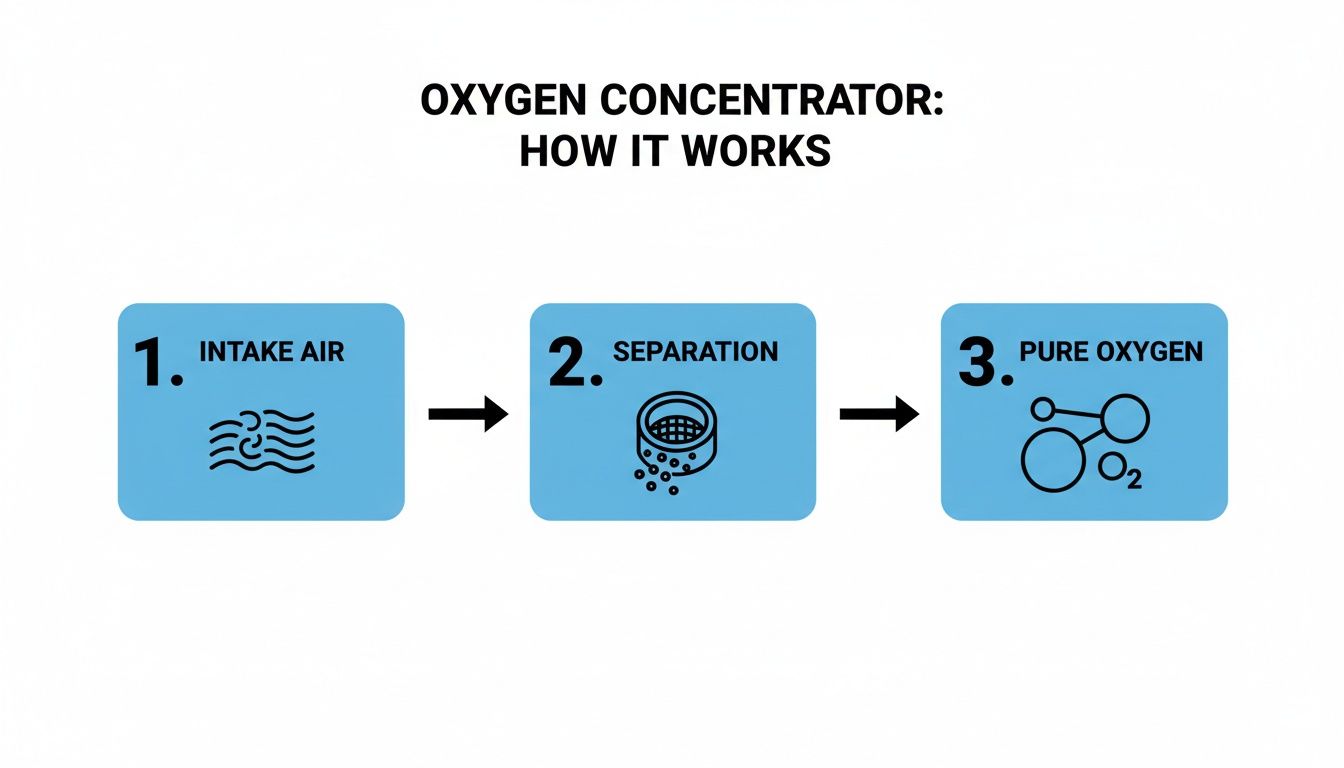
It’s a great visual for understanding how ordinary room air is transformed into the therapeutic oxygen you need, all within one self-contained device.
Putting It All Together for High-Purity Oxygen
This whole process is incredibly efficient. Under pressure swings of about 20-40 psi, the zeolite molecular sieves are designed to capture nitrogen molecules up to five times faster than oxygen molecules. It’s this rapid, selective absorption that allows the machine to produce air with 87-95% oxygen purity.
This technology has been refined over decades. First developed for aviation after World War II, it was adapted for medical use in 1973. Today, it’s so effective that 95% of patients can reach a healthy blood oxygen saturation level (SpO2) of 92% or higher within just a few hours of starting therapy.
The real beauty of Pressure Swing Adsorption is how simple and reliable it is. It uses basic physics—pressure—to physically sort gases. No chemicals, no complex reactions, just a dependable way to generate medical-grade oxygen from the air all around us.
Here at Affinity Home Medical Equipment, we believe in keeping things straightforward. As a direct-to-consumer provider, we do not work with insurance companies. This allows us to offer transparent pricing for sales and rentals without the hassle of insurance paperwork. If you found this helpful, you can find more practical guides on our medical equipment news and blog.
Portable Vs. Stationary: Which Oxygen Concentrator Is Right For You?

Now that you know the basics of how an oxygen concentrator works, the next big step is figuring out which type is the right match for your day-to-day life. It really boils down to two main options: stationary units built for home use and portable models designed to keep you on the move. Each one has its own strengths, and your personal needs are what will ultimately guide your decision.
Think of stationary concentrators as the dependable workhorses of oxygen therapy. These machines plug into a standard wall outlet and are built to run 24/7. This makes them the go-to choice for overnight use or for anyone who needs a steady, reliable oxygen supply while at home. They're known for being incredibly durable and often provide higher oxygen flow rates than portable units.
Portable oxygen concentrators (POCs), on the other hand, are all about freedom. These are compact, lightweight, battery-powered devices made to go wherever you do. Whether it’s a trip to the grocery store, a visit with family, or even a flight across the country, a POC makes it possible. The trade-off for that mobility, however, is a different way of delivering oxygen.
Continuous Flow vs. Pulse Dose Delivery
One of the biggest differences between stationary and portable units is how they deliver oxygen. This is a critical factor in your decision, and it comes down to two methods: continuous flow and pulse dose.
-
Continuous Flow: Just like it sounds, this method supplies a constant, steady stream of oxygen. It doesn't matter if you're breathing in or out; the flow never stops. Nearly all stationary home units operate this way, with the output measured in Liters Per Minute (LPM). This unwavering supply is especially important during sleep, when our breathing naturally becomes more shallow and irregular.
-
Pulse Dose: This is the smarter, more efficient technology found in most portable concentrators. A pulse dose machine has a built-in sensor that detects the very start of your inhalation. The moment it senses you breathing in, it delivers a puff, or "bolus," of oxygen. By only delivering oxygen when you need it, this method saves a tremendous amount of battery life.
A crucial point to remember: a pulse dose setting of "2" is not the same as a continuous flow of 2 LPM. They are measured differently, and only your doctor can determine the correct delivery method and setting for your specific health needs.
Comparing Stationary and Portable Oxygen Concentrators
To make things a little clearer, here’s a quick side-by-side look at the key differences to help you weigh the pros and cons based on what’s most important for your lifestyle.
Stationary (Home) Concentrator
- Primary Use: At home, especially for sleep or round-the-clock therapy
- Power Source: Plugs into a wall outlet (AC power)
- Oxygen Delivery: Continuous flow (steady stream)
- Weight: Heavier (30–50+ lbs), usually on wheels for room-to-room moving
- Size: Larger, about the size of a piece of carry-on luggage
- Best For: Users needing high, uninterrupted flow rates or overnight oxygen
Portable Concentrator
- Primary Use: On the go, travel, errands, and maintaining an active lifestyle
- Power Source: Rechargeable batteries (AC/DC charging options)
- Oxygen Delivery: Pulse dose (on-demand puffs); some offer continuous flow
- Weight: Lightweight (3–18 lbs), designed to be carried
- Size: Compact, often fits in a shoulder bag or backpack
- Best For: Users who are active and need oxygen outside the home
Ultimately, this comparison highlights that one type isn’t universally "better"—it’s all about finding the right tool for the job.
Making The Choice That Fits Your Life
So, how do you decide? It really comes down to how you live. If you spend most of your time at home or need oxygen primarily while you sleep, a stationary unit is your most reliable and cost-effective choice. They are built to last for years with minimal fuss.
If you’re determined to stay active and need oxygen support to do it, a portable concentrator is the obvious answer. For many of our customers, the best solution is actually a combination of both: a stationary machine for reliable home use and a POC for maintaining their independence out in the world.
At Affinity Home Medical Equipment, we believe in straightforward and transparent pricing for both options. Because we do not work with insurance, we can give you a clear cost upfront, without the confusion of co-pays and deductibles. You can explore our St. Petersburg oxygen concentrator sales and rentals to see which models might be a good fit for you.
Getting to Grips with Flow Rates and Oxygen Purity
When your doctor writes you a prescription for oxygen therapy, they'll give you two very important numbers: your flow rate and your required oxygen purity. Think of these as the precise dosage for your oxygen "medication." Getting them right is the key to making your therapy work.
Your flow rate is simply how much oxygen the machine sends your way, and it's measured in Liters Per Minute (LPM). Your doctor will figure out the exact LPM you need based on your health and your blood oxygen levels. It’s absolutely critical that you set your machine to that prescribed number and never change it on your own.
Lots of people think that if they feel short of breath, they should just turn up the flow rate to get "more" oxygen. That's a common and dangerous mistake.
Why Turning Up the Flow Rate Doesn't Mean Better Oxygen
There's a persistent myth that cranking up the LPM will somehow water down the oxygen you're getting. The truth is, a well-made oxygen concentrator is designed to deliver consistently pure oxygen, no matter which flow setting you're using. That’s just how they’re built.
So, whether your doctor has you on 2 LPM or 5 LPM, the machine's internal filters (the sieve beds) are working to produce oxygen that's between 90-95% pure. The machine is only changing the volume of that purified air it's sending you, not the quality. Sticking to your prescribed LPM is the only way to ensure your body gets the exact amount of oxygen it needs.
Following your doctor's prescribed flow rate is non-negotiable. Quality concentrators are built to maintain high oxygen purity (90-95%) at every setting, so changing your LPM won't improve the oxygen concentration—it will only deliver an incorrect and potentially unsafe dosage.
Today's concentrators are remarkably good at their job. Inside the machine, sieve beds use pressure (around 40 psi) to grab onto nitrogen molecules from the air, letting a steady stream of 93% pure oxygen (±3%) pass through to you.
This holds true for continuous flow units, which make up 55% of the market and are often the best choice for those with sleep apnea who need a constant 2-5 LPM, as well as for the more compact pulse-dose models. You can dig deeper into the market trends by reviewing key industry findings on oxygen concentrator technology.
Here at Affinity Home Medical Equipment, we are a direct-to-consumer provider. Because we do not work with insurance, we can be completely transparent with our pricing, so you know exactly what to expect. You can see all of our available models by visiting our online medical equipment shop. Understanding how your equipment works is the first step toward taking control of your respiratory health with confidence.
Essential Maintenance and Safety You Need to Know

Knowing how your oxygen concentrator works is one thing; keeping it running safely day in and day out is another. A little bit of routine care goes a long way. Think of it like changing the oil in your car—it’s a simple habit that prevents bigger problems and keeps your machine humming along reliably for years.
The good news is that basic maintenance is straightforward. Your main job is to keep things clean and clear, starting with the external filter. This filter, sometimes called a gross particle filter, is the machine’s first defense against everyday airborne nuisances like dust, lint, and pet hair.
When that filter gets clogged, the concentrator has to work overtime to pull in enough air. That extra strain can wear out the internal parts much faster. So, try to get in the habit of checking it once a week. A quick wash with some mild soap and warm water is usually all it needs.
Your Simple Maintenance Checklist
Every machine is a little different, so your user manual is always your best guide. But for the most part, keeping your concentrator in tip-top shape comes down to these three tasks.
- Clean the External Filter Weekly: Gently pop the filter out and give it a wash. The most important part? Make sure it is completely dry before you put it back in. A damp filter is a fast track to internal damage.
- Wipe Down the Machine: Use a soft, damp cloth to clean the concentrator's outer cabinet. This keeps dust from accumulating around the air intake vents, ensuring it can breathe easily.
- Inspect Tubing and Cannulas: Give your nasal cannula and tubing a regular once-over. Look for any moisture buildup, cracks, or kinks that could block airflow. It’s best to replace these parts every month or so, or however often your provider recommends.
Non-Negotiable Safety Rules
Beyond keeping it clean, operating your concentrator safely is absolutely critical. Remember, the machine produces highly concentrated oxygen. While the oxygen itself isn't flammable, it creates an environment where fires can start much more easily and burn far hotter and faster.
Because of this, you have to be vigilant. These rules are not optional.
- No Smoking or Open Flames: This is the big one. Keep the concentrator and yourself at least 10 feet away from any open flame. That means no candles, gas stoves, fireplaces, and absolutely no lit cigarettes.
- Ensure Proper Ventilation: Never, ever run the machine in a tight, enclosed space like a closet. It needs plenty of fresh air to pull from and space to vent the nitrogen it removes.
- Avoid Extension Cords: Always plug the concentrator directly into a wall outlet. Extension cords aren’t designed for the consistent power draw and can overheat, creating a serious fire hazard.
- Keep It Away From Heat: Position the machine away from radiators, space heaters, or spots that get a lot of direct sunlight.
Following these simple maintenance and safety tips is the best way to guarantee your oxygen concentrator how it works properly and safely for years. Consistent care not only protects your investment but, more importantly, protects your well-being.
Here at Affinity Home Medical Equipment, we are a direct-to-consumer provider and do not work with insurance companies. This allows us to offer simple, transparent pricing without the hassle. For anyone in Pinellas County needing a short-term solution, we also have a great selection of St. Petersburg medical equipment rentals.
Your Top Questions Answered
Let's walk through some of the most common questions we hear from folks just getting started with oxygen therapy. Getting clear, simple answers can make all the difference in feeling comfortable and confident with your equipment.
Does an Oxygen Concentrator Ever Run Out of Oxygen?
Nope, it can't! As long as your concentrator has power and is in a room with decent air circulation, it will never run out of oxygen. Think of it this way: an oxygen tank is like a water bottle—it holds a limited amount. An oxygen concentrator, on the other hand, is like a water filter attached to your faucet. It continuously takes the air around you, filters out the nitrogen, and delivers a steady, endless supply of purified oxygen.
It's a self-sufficient little factory, not a storage tank. This is one of the biggest benefits and a huge source of peace of mind for users.
Do I Really Need a Prescription for an Oxygen Concentrator?
Yes, a prescription from your doctor is non-negotiable. Oxygen is considered a medical treatment, just like a prescription drug. Your doctor needs to determine the exact flow rate—measured in Liters Per Minute (LPM)—that your body requires to stay healthy.
Getting the right amount of oxygen is crucial for your safety and for the therapy to actually work. Your prescription ensures we set up your equipment to the precise settings your doctor has ordered for you.
How Loud Are These Machines?
You'll definitely hear it running, but modern concentrators are surprisingly quiet. Most stationary home units hum along at about 40 to 50 decibels. That's roughly the same sound level as a modern refrigerator or a quiet conversation. It’s generally a low, consistent background noise that most people get used to very quickly, allowing them to sleep, watch TV, and chat without any trouble.
Can I Travel with a Portable Oxygen Concentrator?
You bet! That’s exactly what they're made for. Most portable oxygen concentrators (POCs) are approved by the FAA for use on airplanes, which opens up a world of travel possibilities. They're designed to be lightweight and run on batteries, so you can stay active and on the go. Just be sure to check that the specific model you choose is FAA-approved and can meet your oxygen needs for the duration of your trip.
Have more questions about our equipment or services? We've answered many more on our complete frequently asked questions page.
Here at Affinity Home Medical Equipment, we're dedicated to giving our St. Petersburg community clear answers and practical solutions. We do not work with insurance, which allows us to offer simple, direct pricing on all our equipment rentals and sales. If you're still wondering about something or need a hand picking the right device, just give us a call. We're here to help.
Share This Article

Written by : lori@netcodesign.com
Follow Us
Latest Articles

October 14, 2026

October 14, 2026

October 14, 2026
