
Oxygen Concentrator Vs Oxygen Tank A Practical Comparison

When your doctor prescribes oxygen therapy, you're faced with a [...]
When your doctor prescribes oxygen therapy, you're faced with a choice that boils down to a simple concept: supply. Oxygen tanks store a finite amount of compressed oxygen and need to be refilled, while an oxygen concentrator generates its own unlimited supply by purifying the air around you. The best option for you really depends on whether you need a simple, short-term solution or want more long-term independence.
Making The Right Choice For Your Oxygen Needs
Receiving a prescription for supplemental oxygen is a big step, and the next decision—choosing between an oxygen concentrator and an oxygen tank—will directly impact your day-to-day life. This isn't just a choice about medical equipment; it’s about your freedom, safety, and how you manage costs over time. Getting to grips with how each system works is the first, most important step toward a decision you can feel good about.
Think of an oxygen tank like a classic scuba tank. It’s a durable metal cylinder that holds a specific amount of compressed or liquid oxygen. Once it’s empty, it has to be refilled or replaced by a delivery service, which can sometimes make your schedule feel a bit rigid.
An oxygen concentrator, on the other hand, is a modern medical device that works a lot like a high-tech air purifier. It pulls in the air from the room, filters out the nitrogen, and delivers a steady, concentrated stream of medical-grade oxygen. This self-sufficiency is a game-changer for many people, as it completely removes the hassle of deliveries and the worry of unexpectedly running out.
Key Factors In Your Decision
To help you visualize the choice, this decision tree breaks down the most important factors based on your prescription and lifestyle.
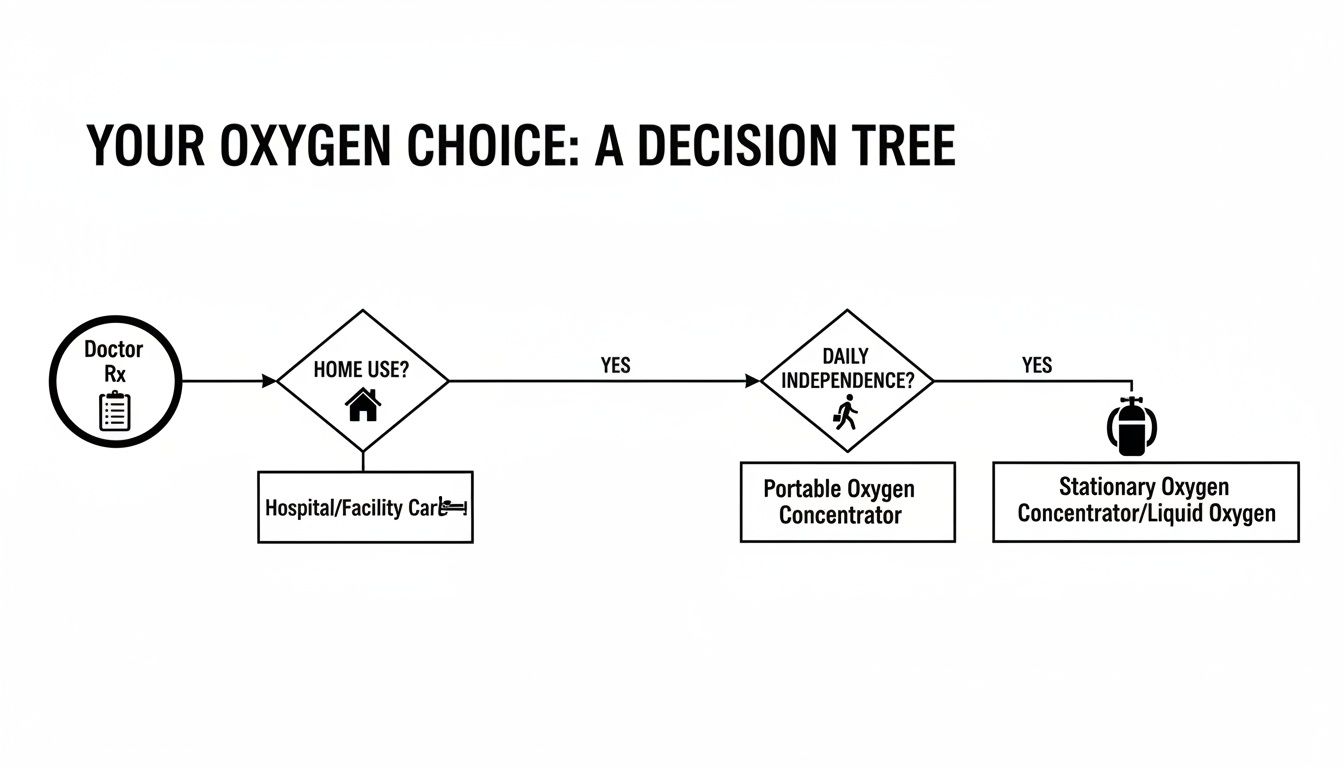
As you can see, if maintaining daily independence and using oxygen at home for the long haul are your top priorities, an oxygen concentrator is almost always the recommended path.
To make things even clearer, let's look at a quick side-by-side comparison.
Oxygen Concentrator Vs Tank Key Differences
This quick comparison highlights the fundamental differences between the two main types of oxygen therapy systems.
- Oxygen Source: An oxygen concentrator filters and concentrates air from the room, while a tank stores a finite amount of compressed oxygen.
- Supply: A concentrator offers an unlimited supply as long as there is power. A tank has a limited supply and requires refills or replacement.
- Portability: Portability varies with concentrators, but portable models are lightweight. Tanks are generally heavy and cumbersome.
- Power Source: A concentrator requires electricity or battery power. A tank needs no power source.
- Cost: A concentrator has a higher initial purchase price but a lower long-term cost. A tank has a lower initial cost but ongoing rental and refill fees.
- Safety: A concentrator has no risk of pressurized contents leaking. A tank has a risk of fire if stored or handled improperly.
Ultimately, a concentrator offers a "make-your-own" approach, while a tank is a "pre-packaged" solution. Your personal needs and lifestyle will determine which is the better fit.
Considering The Financial Aspect
It's also important to think about the financial side of things. We want to be upfront: we do not take insurance. This allows us to provide clear, straightforward pricing for both rentals and purchases without the headaches and delays of dealing with insurance claims.
For many of our clients, purchasing a concentrator is a bigger investment at the start, but it often becomes the more affordable choice over time. You eliminate the recurring monthly rental and delivery fees that come with oxygen tanks, which can add up significantly.
How Oxygen Is Delivered: Created vs. Stored
The first thing to wrap your head around is the fundamental difference in how these two systems get oxygen to you. It's really a story of creating it versus storing it. An oxygen concentrator makes an endless supply on the spot, while a tank holds a set amount that will eventually run out.
An oxygen concentrator is a clever machine that acts like a tiny, personal oxygen factory. It pulls in the regular air around you—which is about 78% nitrogen and 21% oxygen—and filters it.
The magic happens inside, using a process called pressure swing adsorption. The machine compresses the air and pushes it through filters made of a material called zeolite. Think of zeolite as a bouncer at a club; it grabs onto the larger nitrogen molecules and lets the smaller oxygen molecules pass right through. What comes out is a steady stream of highly purified oxygen, usually between 90% and 95% pure, ready for you to breathe.
The Concentrator: Your Personal Oxygen Source
The real beauty of this system is its self-sufficiency. As long as the concentrator has power, you have an unlimited supply of medical-grade oxygen. This completely gets rid of the need for deliveries and erases the nagging worry of running out at an inconvenient time.
It’s no surprise that this technology is becoming more common. The global oxygen concentrator market was recently valued at $4.85 billion and is expected to climb to $8.31 billion by 2033. This surge is driven by a growing number of people needing long-term oxygen therapy for conditions like COPD, especially as our population ages. Stationary (or home) concentrators lead the market because they offer higher oxygen output for a lower long-term cost than portable models, without the logistical headache of tank refills. You can dig into more of the data behind these trends over at Grand View Research.
The main thing to remember is that a concentrator doesn't store oxygen; it produces it in real-time. This is the core reason it offers so much independence and peace of mind for people who need therapy at home.
The Tank: A Simple, Stored Supply
Oxygen tanks, on the other hand, are much more straightforward. They don't make anything. Instead, they store pure oxygen, compressed under high pressure inside a sturdy steel or aluminum cylinder. The oxygen in these tanks is incredibly pure, typically 99% to 100%, meeting strict medical-grade standards.
Tanks hold oxygen in one of two ways:
- Compressed Gas: This is the most common type, where gaseous oxygen is squeezed into the cylinder at pressures around 2,200 PSI.
- Liquid Oxygen: For this method, oxygen is chilled to a frigid -297°F, turning it into a liquid. This allows a massive amount of oxygen to be stored in a much smaller, lighter tank.
To get the oxygen out, you attach a regulator to the top of the tank. This crucial device lets you dial in the precise flow rate your doctor prescribed by controlling the pressure. But remember, the supply is limited. Once a tank is empty, it's done until it can be refilled or swapped out by a professional service. This reliance on a supplier is a huge factor when deciding between an oxygen concentrator vs. an oxygen tank, shaping your entire daily routine.
Portability and Daily Independence: How Your Choice Shapes Your Life
When it comes to supplemental oxygen, the choice between a concentrator and a tank isn't just a medical decision—it's a lifestyle one. One system integrates into your daily routine, while the other forces you to plan your routine around it. For anyone who values an active and independent life, understanding this difference is everything.
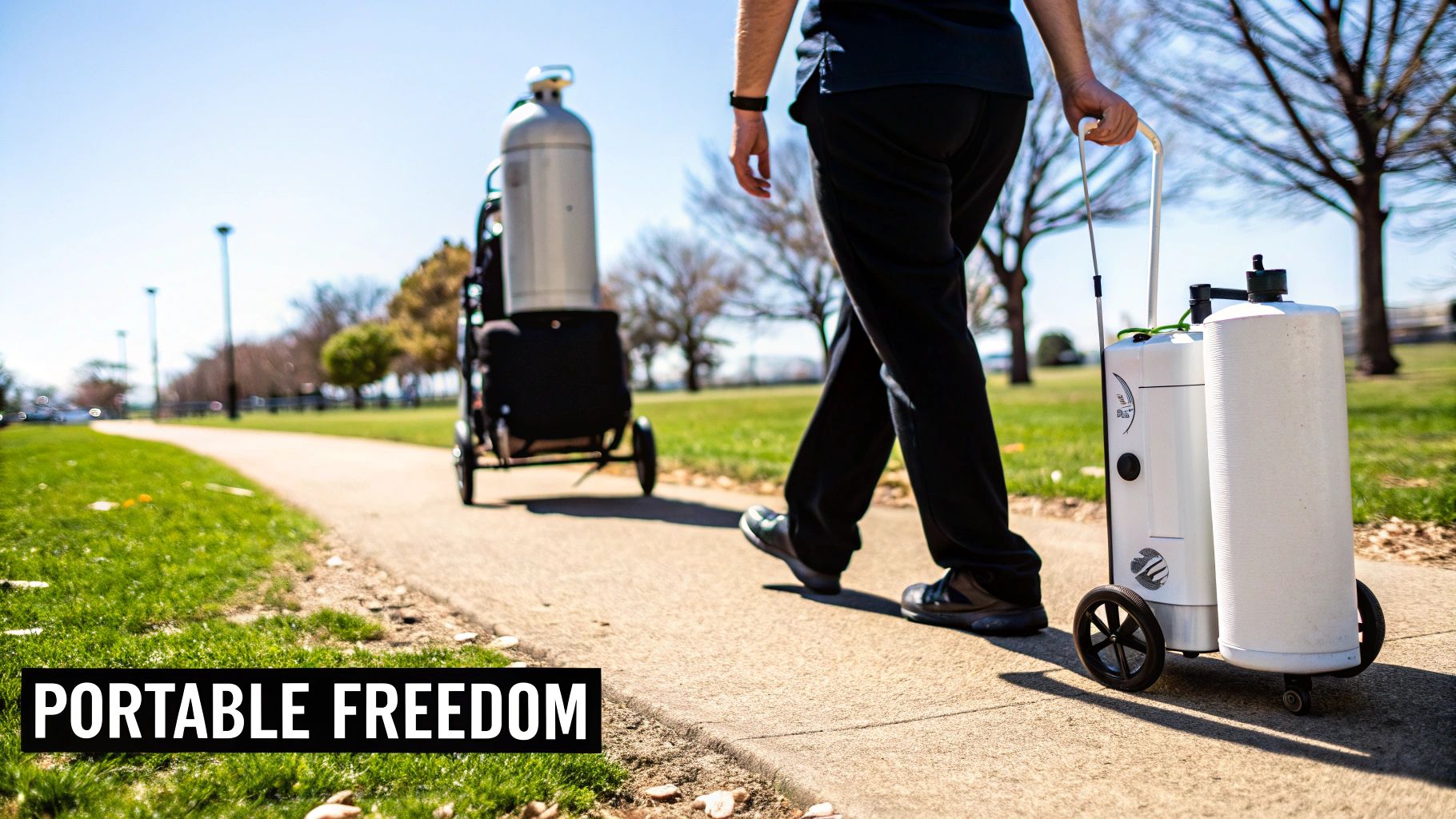
Let's be realistic about traditional oxygen tanks. Even the smaller "portable" models, like the common E-tank, are bulky. An E-tank is over two feet long and weighs close to 8 pounds, which almost always means lugging around a rolling cart. This turns simple outings, like a grocery run or a walk through a St. Petersburg park, into a major logistical hurdle.
Beyond the physical burden is the mental one. Many tank users talk about "oxygen anxiety"—that constant, nagging worry in the back of your mind about how much oxygen you have left. Every activity has a time limit, dictated by the gauge on your cylinder. It’s exhausting and incredibly restrictive.
The Freedom of a Portable Oxygen Concentrator
This is where portable oxygen concentrators (POCs) completely change the game. These devices, some weighing less than five pounds, deliver true, untethered freedom. A POC works by pulling in the surrounding air and generating a continuous supply of medical-grade oxygen, so you never have to think about running out or scheduling a refill.
This technology empowers you to:
- Travel on a whim: Take that long car trip to see family or go on vacation without having to haul a trunk full of heavy tanks.
- Enjoy your day: Run errands, meet friends for lunch, or just spend time outdoors without being tethered to a cart.
- Take back control: You’re no longer dependent on a delivery schedule. You manage your oxygen therapy on your own terms.
The market is clearly shifting in this direction. The portable oxygen concentrator industry is projected to grow from $1.27 billion to $1.71 billion by 2030. This boom is driven by people demanding lightweight designs, longer-lasting batteries, and the profound independence these devices provide.
From Restriction to Empowerment: It’s a Mindset Shift
The biggest difference isn't just about the technology or the weight; it's the change in mindset. An oxygen tank can feel like an anchor, dictating where you can go and for how long. A portable concentrator, on the other hand, just becomes a part of your life, empowering you to keep your routines and chase your passions.
With a tank, your day is planned around your oxygen supply. With a portable concentrator, your oxygen supply fits into your day.
This feeling of empowerment is crucial for mental and emotional well-being. The ability to join in on the activities you love, without your equipment holding you back, is one of the most powerful benefits of modern oxygen therapy.
Real-World Scenarios: Tank vs. Concentrator
Let’s walk through a couple of everyday situations to see how this plays out.
Scenario 1: Going Out for Lunch with a Friend
- Oxygen Tank User: First, you have to check the gauge. Is there enough for a few hours? You'll need to load the tank and cart into your car. At the restaurant, you have to find a spot for the cart where it won't trip anyone. All the while, the clock is ticking on your supply.
- POC User: You grab your lightweight POC, slip it into its shoulder bag, and you're out the door. You can even plug it into your car's outlet on the way to save battery. At the table, it sits quietly beside you, and you can stay as long as you like.
Scenario 2: A Weekend Trip to See the Grandkids
- Oxygen Tank User: This requires serious planning. You’d have to coordinate with your oxygen company to get enough tanks delivered to your destination or figure out how to transport several heavy cylinders in your car, which raises safety issues.
- POC User: You just pack your POC, batteries, and chargers. Most portable units are FAA-approved for flights, and you can simply recharge it overnight when you arrive. You have total freedom for the entire trip. To learn more about different therapy options, feel free to check out our medical equipment blog.
It is crucial to be aware of the financial aspects of your decision. We operate on a direct-to-consumer model and do not take insurance. This approach allows us to offer straightforward, transparent pricing without the complexities and delays common with insurance billing. By providing clear costs for both rentals and purchases, we help you make an informed financial decision that best suits your long-term needs and budget.
Understanding Oxygen Flow and Delivery
One of the biggest, and most important, differences between an oxygen concentrator and an old-school oxygen tank is how the oxygen gets to you. This isn’t just a minor technical detail—it’s the core of your oxygen therapy and it's dictated entirely by your doctor's prescription. The two delivery methods are continuous flow and pulse dose, and you can't just swap one for the other.
An oxygen tank is simple. It delivers a continuous flow of oxygen. When you open the valve, oxygen comes out in a steady, constant stream at the rate your doctor prescribed, measured in liters per minute (LPM). It doesn't matter if you're breathing in or out; the oxygen just keeps coming.
This constant supply is non-negotiable for certain medical needs. For example, people who tend to breathe through their mouths, especially while sleeping, need that continuous flow to ensure they’re getting enough oxygen. Some lung conditions also require the kind of unwavering consistency only a tank can provide.
How Concentrators Change the Game
This is where oxygen concentrators really offer some flexibility. Depending on the model you have, a concentrator can provide one or both types of flow.
- Stationary (Home) Concentrators: These are the larger units that plug into a wall outlet. They are workhorses, built to run 24/7, and are powerful enough to provide a continuous flow of oxygen, just like a tank. They're the go-to for use at home and especially overnight while sleeping.
- Portable Oxygen Concentrators (POCs): To make them small, lightweight, and able to run on a battery for hours, most POCs use what’s called a pulse dose system. It’s a smarter, more efficient way to deliver oxygen.
So, How Does Pulse Dose Work?
Pulse dose technology is all about efficiency. The device has a sensitive internal sensor that detects the very beginning of your inhalation. The instant it senses you’re about to breathe in, it delivers a "bolus," or a small puff, of oxygen. It’s timed perfectly with your natural breath.
This means absolutely no oxygen is wasted while you're exhaling, which is what allows the battery to last so much longer. It's the key innovation that makes modern, lightweight portable oxygen a reality. But this efficiency comes with a trade-off that you absolutely must understand.
It's a common and dangerous mistake to think that a pulse dose setting of "2" is the same as a continuous flow of 2 LPM. They are not the same thing. Your prescription is specific, and your doctor is the only one who can say if a pulse dose setting is right for your medical needs.
The Critical Difference: Pulse vs. Continuous
You can't compare a pulse setting to a continuous flow rate directly. A continuous flow of 2 LPM means you are getting two full liters of oxygen every single minute, no matter what. A pulse setting of "2," however, delivers a pre-measured volume of oxygen each time you take a breath.
This means the total amount of oxygen you get over a minute actually changes with your breathing rate. If you're resting and your breathing is slow and deep, you might get less total oxygen than someone with a faster breathing pattern, even on the same setting. This variability is exactly why your doctor's input is non-negotiable. Using the wrong delivery method can mean you're not getting enough oxygen, which can have serious consequences for your health.
When talking with your doctor, make sure you cover your oxygen needs in every situation:
- At rest, just sitting or watching TV.
- During activity, like walking around the house or shopping.
- While sleeping, when your breathing pattern naturally changes.
Here at Affinity Home Medical Equipment, your safety is our first concern. We will always confirm your prescription to make sure the machine you get—whether it's a rental or a purchase—is exactly what your doctor ordered. You can see what we have available by checking out our St. Petersburg oxygen concentrators for sale and rent.
We also believe in being completely upfront about costs. It's important for you to know that we do not take insurance. We’ve found this allows us to offer simple, clear pricing without the long delays and confusing paperwork of insurance claims. By working directly with you, we can get you what you need immediately and provide straightforward costs, helping you make the best financial decision for your family. In the end, your doctor's prescription is what truly settles the "oxygen concentrator vs. oxygen tank" debate, ensuring your health always comes first.
Looking at Safety, Maintenance, and the True Cost
Once you get past the daily questions of portability and flow rates, the long-term realities of safety, upkeep, and total cost really start to show the sharp differences between oxygen concentrators and tanks. These are the factors that will ultimately affect your budget and your peace of mind.
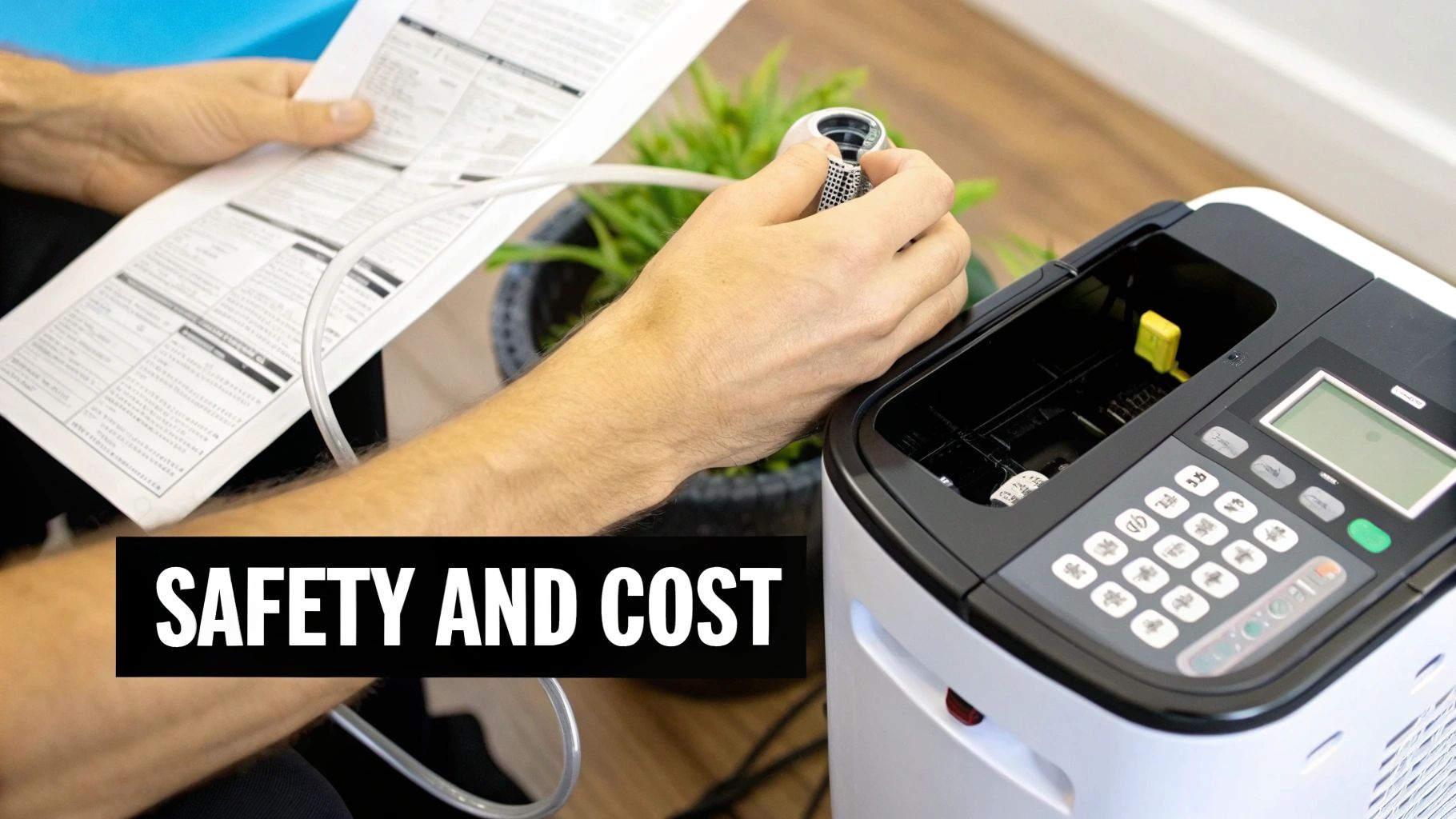
With any piece of medical equipment, safety has to be the top priority. Oxygen tanks store pure, compressed oxygen at incredibly high pressures—often around 2,200 PSI. This high pressure makes them a serious fire hazard if a leak develops. Oxygen-saturated environments don't just start fires; they make them burn hotter and spread faster.
There's also a physical risk. If one of these heavy metal cylinders gets knocked over, it could damage the valve and lead to a violent, uncontrolled release of pressure. It’s a genuine concern in any household.
In contrast, oxygen concentrators are fundamentally safer. They don't store any compressed gas. Instead, they pull in ambient air and produce oxygen as needed, which eliminates all the risks tied to high-pressure storage. That simple fact makes them a much more secure and worry-free option for using oxygen at home.
Upkeep: Dependency vs. Independence
The maintenance for these two systems couldn't be more different, and it directly affects how much control you have over your own life. Using an oxygen tank means you are completely dependent on a supplier. You have to plan your days around delivery schedules for refills and constantly check your gauges so you don't run out unexpectedly.
It's a never-ending cycle of scheduling, waiting, and worrying that can add a lot of unnecessary stress to your routine.
An oxygen concentrator, on the other hand, puts you back in the driver's seat. The maintenance you're responsible for is minimal and incredibly simple.
- Filter Cleaning: Most concentrators have a filter that just needs a quick wash with soap and water about once a week.
- Cannula Replacement: For hygiene and performance, the tubing should be swapped out on a regular schedule.
- Annual Servicing: We recommend a yearly professional check-up to make sure the machine is running perfectly.
This straightforward routine breaks the cycle of dependency. It frees you from relying on a delivery service and offers a truly self-sufficient way to manage long-term oxygen therapy.
The real comparison in upkeep is dependency versus independence. Tanks tie you to a delivery schedule, while concentrators empower you to manage your own therapy with minimal effort.
A Clear Look at the Total Cost of Ownership
When you start comparing the finances, you have to look past the initial price. The total cost of ownership over several months or years reveals the real financial picture.
Oxygen tanks usually look cheaper at first, often coming with a low monthly rental fee. But that's just the starting point. You'll also have recurring fees for every oxygen refill and each delivery. Those costs add up month after month, making tanks the more expensive choice over the long haul.
Oxygen concentrators have a higher upfront purchase price or a higher monthly rental fee. After that, however, the only ongoing cost is the small amount of electricity it takes to run it. For anyone needing oxygen long-term, buying a concentrator is almost always the smarter financial move. You completely eliminate those endless refill and delivery bills, saving a significant amount of money over time.
Feel free to browse our online shop for medical equipment to see your options.
It's important to note how we handle payment so you can budget accordingly. We operate on a direct-pay basis and do not take insurance. This allows us to offer simple, transparent pricing without the frustrating delays and red tape of insurance claims, helping you make a clear and informed financial decision from day one.
Finding Your Oxygen Solution In Pinellas County
Deciding between an oxygen concentrator and an oxygen tank feels a lot less daunting when you have local experts to talk to. For anyone living in St. Petersburg or the surrounding Pinellas County area, having a team you can meet with face-to-face can make all the difference. We see ourselves as consultants, here to walk you through the practical, real-world pros and cons of each system so you can feel confident in your choice.
We also know that dealing with the financial side of medical equipment can be a headache. That’s why we keep it simple. We do not take insurance, which allows us to offer straightforward, transparent pricing without the endless paperwork and approval delays. This direct approach means we can focus on getting you the right equipment, right when you need it.
Hands-On Guidance and Flexible Options
One of the best things about working with a local provider is the ability to actually see and handle the equipment before you decide. In our showroom, you can feel the weight difference between a portable concentrator and a small oxygen tank. You can even listen to how quiet different models are. That hands-on experience is something you just can’t get online.
We also offer rental programs designed for all sorts of situations. Maybe you just need a concentrator for a few days while recovering from surgery, or perhaps you want to try out a specific model for a month before committing to a purchase. We have flexible plans to fit your needs.
Choosing a local partner means you get more than just a piece of equipment; you get personalized support, immediate access, and the peace of mind that comes from making an informed choice for your health and independence.
Many of our in-stock items are available for same-day pickup, so you won't have to wait for the support you need. Our goal is to find the right solution for your safety, mobility, and lifestyle without any delay. To see what's available for short-term needs, you can learn more about our St. Petersburg medical equipment rentals. Our team is here to help every step of the way.
Your Oxygen Therapy Questions, Answered
Starting oxygen therapy naturally comes with a lot of questions. From understanding the difference between an oxygen concentrator and an oxygen tank to figuring out the logistics of daily life, getting clear answers is key. We've put together some straightforward information to help you feel confident in your decisions.
It's also worth noting that we handle pricing a bit differently. To keep things simple and transparent, we do not take insurance. This direct approach means we can offer clear, upfront costs for both rentals and purchases, so you can budget without worrying about insurance delays or surprise bills.
Do I Need a Prescription for an Oxygen Concentrator or Tank?
Yes, a prescription is non-negotiable. The FDA classifies both oxygen concentrators and tanks as medical devices, and for good reason. Your doctor's prescription is what tells us the precise oxygen flow rate and usage schedule your specific health condition requires. To ensure your therapy is safe and effective, we must have a valid prescription from your doctor before we can rent or sell you any oxygen equipment.
Can I Use a Portable Oxygen Concentrator While I Sleep?
That's a conversation you need to have with your doctor. The answer really depends on your breathing patterns and the type of machine. Most portable oxygen concentrators (POCs) deliver a pulse dose, meaning oxygen is released only when you inhale. For some people, this isn't a problem. But if you're a shallow breather or tend to breathe through your mouth while sleeping, the machine might not detect your breath and won't deliver oxygen.
Some newer POCs do have a continuous flow setting, which can work for sleep. However, it's absolutely critical to get your physician's approval. They might decide a stationary, continuous-flow concentrator is the safer bet for overnight use to ensure you get an uninterrupted oxygen supply.
How Loud Is an Oxygen Concentrator?
You’ll be pleasantly surprised. Today’s oxygen concentrators are designed to be pretty quiet, easily fading into the background noise of a home.
- Stationary Home Units: These typically produce sound in the 40-58 decibel (dBA) range—about the same as a modern refrigerator's gentle hum.
- Portable Models: Portables are often even quieter, running between 37-45 dBA, which is comparable to the hush of a library.
While most people don't find the sound disruptive, very light sleepers might notice it at first. If you're in Pinellas County, we encourage you to stop by our showroom to hear a few models for yourself. It’s the best way to know what to expect. For more answers, feel free to check out our detailed FAQ page.
Ready to find a safe, reliable oxygen therapy solution in St. Petersburg? The team at Affinity Home Medical Equipment is here to offer expert guidance and flexible options that fit your life. Whether you want to rent or buy, visit us online or stop by our showroom to get started.
Share This Article

Written by : lori@netcodesign.com
Follow Us
Latest Articles

October 12, 2026

October 12, 2026

October 12, 2026

