
Transport Wheelchair vs Standard Wheelchair: Deciding What’s Right

When you're looking at a transport wheelchair vs a standard [...]
When you're looking at a transport wheelchair vs a standard wheelchair, the biggest difference boils down to a single question: who is moving the chair? A transport wheelchair needs a caregiver or companion to push it, whereas a standard wheelchair is designed for the user to propel themselves. That's the heart of the matter, and your choice really hinges on whether the user wants independence or will always have assistance for mobility.
Your Quick Guide To Wheelchair Types

Picking the right wheelchair isn't just a practical decision; it directly shapes daily life, comfort, and freedom for both the person using it and their caregiver. Getting a handle on the key differences between a transport model and a standard one is the first, most crucial step.
At a glance, they might seem similar, but their designs are built for completely different situations. A transport chair is all about being lightweight and portable. It’s the perfect tool for quick outings, travel, and any scenario where a caregiver is always on hand to help. Its smaller wheels and simple frame make it a breeze to fold up and pop into the trunk of a car.
A standard wheelchair, on the other hand, is built for autonomy. Those large rear wheels with hand rims are there for a reason—they empower the user to get around on their own, encouraging independence and making it easier to navigate a full day's activities. These chairs are generally more robust and offer more support for long-term use. You can see the variety firsthand when you explore options for wheelchairs in St. Petersburg, FL.
The key takeaway is simple: Transport chairs are for being pushed. Standard wheelchairs are for self-propulsion. One is for assisted mobility, the other for independence.
Making the right call means looking past the obvious. You have to consider the user's physical strength, where the chair will be used most often, and how long it will be needed. This guide will walk you through all the details to make sure you find the perfect match for your specific needs.
Comparing Critical Design and Functional Differences
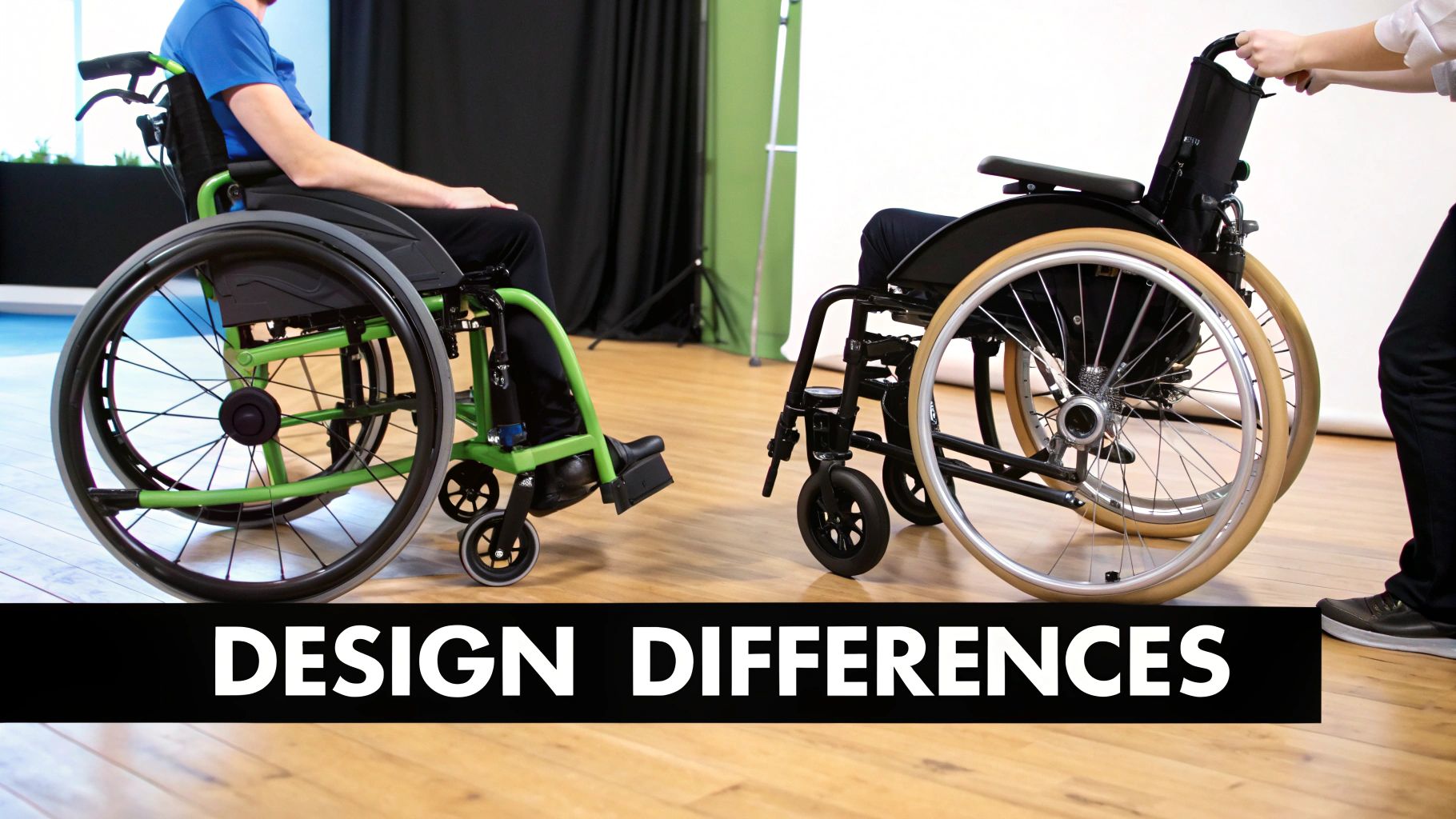
When you put a transport wheelchair vs a standard wheelchair side-by-side, you see that the differences are more than just cosmetic. Every part of their design serves a specific purpose, shaping the day-to-day experience for both the user and their caregiver. Getting to know these critical distinctions is the first step in making the right choice.
The wheels are the most obvious giveaway. A transport chair has four small wheels, usually around 8 to 12 inches in diameter. This isn't by accident; that smaller footprint makes the chair incredibly nimble for navigating tight indoor spaces like a doctor's office hallway or a crowded store aisle.
A standard wheelchair, on the other hand, is easily identified by its two large rear wheels, which typically measure 20 to 24 inches. Those big wheels feature hand rims, which are what allow the user to grab on and propel themselves. It’s a design built for independence.
Weight And Portability
This is a big one. Transport wheelchairs are built from the ground up to be portable. They often use lightweight aluminum frames, bringing their total weight down to as little as 15 to 25 pounds. For a caregiver, this means folding it up, lifting it, and popping it in the trunk of a car is a breeze.
Standard wheelchairs are simply heavier because they need to be more robust for self-propulsion. With steel frames and much larger components, their weight usually falls between 35 and 50 pounds. Most still fold, but that extra heft can be a real challenge for some caregivers to manage day in and day out.
The core trade-off is clear: transport chairs prioritize the caregiver's convenience by being lightweight and compact, while standard wheelchairs prioritize the user's independence with a heavier, more robust build.
This weight difference really dictates where and how each chair shines. A family that's always on the go might find the grab-and-go nature of a transport model perfect. But for someone who needs reliable mobility around their own home, the sturdiness of a standard chair is often the better fit. For more expert takes on mobility equipment, you can always check out the Affinity Home Medical Equipment blog.
Braking Systems And Control
The braking systems are a perfect example of how each chair is designed for a different operator. It’s all about who is in control.
- Transport Wheelchair Brakes: These are made for the caregiver. The brakes are almost always on the push handles, working just like the hand brakes on a bicycle. This lets the person pushing control the speed and lock the wheels firmly in place without ever having to bend over.
- Standard Wheelchair Brakes: These brakes are all about user control. You'll find them as push-to-lock or pull-to-lock levers right next to the large rear wheels, well within reach of the person sitting in the chair. This design puts the user in charge of their own stability and safety.
It might seem like a small detail, but the brake placement says it all. One is a tool for assisted movement managed by a helper, while the other is an instrument for personal freedom.
Situations Where a Transport Wheelchair Excels

When people weigh the choice of a transport wheelchair vs standard wheelchair, the conversation often defaults to the user's independence. But that overlooks a huge part of the picture. The transport model really comes into its own in situations where a companion or caregiver is doing the pushing.
These chairs are purpose-built for assisted movement, which makes them the obvious choice for many short-term or temporary mobility needs.
Consider someone recovering from surgery. They might not have the upper-body strength to move themselves, or their doctor may have advised against it. A transport wheelchair is the perfect, no-fuss solution for getting them safely from the hospital to the car and into their home.
It’s also the ideal tool for quick but essential outings. Think of a series of doctor's appointments or a day of running errands with an elderly family member. For the person pushing, the entire process is far less of a struggle.
The Caregiver Advantage
Let's be honest: the biggest selling point of a transport wheelchair is how much easier it makes things for the caregiver. Its lightweight build is a complete game-changer. Hoisting a 15 to 25-pound chair into the trunk of a car is worlds away from wrestling with a much heavier standard wheelchair.
This portability just makes life easier and opens up the possibility for more spontaneous trips. The chair folds down neatly, taking up very little space in a car or a closet at home. For caregivers, this means less time and energy spent wrangling equipment and more quality time focused on the person they’re helping.
A transport wheelchair is more than just a mobility device for the user; it’s a tool that empowers the caregiver. By making transport easier, it supports a more active and engaged lifestyle for both individuals.
The Best Fit For Temporary Needs
Not every mobility issue is a long-term one. If you're dealing with a sprained ankle or recovering from a minor procedure, buying a wheelchair often doesn't make sense.
This is exactly why renting is such a fantastic option. It gives you the flexibility you need without the commitment of a purchase. By looking into options like St. Petersburg medical equipment rentals, you can find an affordable solution for the precise amount of time you need it.
While powered mobility is on the rise, it’s worth noting that the manual product segment still led the global market in 2022, holding a revenue share of over 61.1%. This highlights the consistent, real-world demand for practical, non-powered chairs.
For total clarity, it's important to know that we do not work with insurance companies. We've chosen this approach to provide clear, upfront pricing and immediate access to equipment. This simplifies the entire process, letting you focus on what really matters: comfort and recovery.
When Independence is the Goal: Choosing a Standard Wheelchair
While a transport chair is a fantastic tool for getting from Point A to Point B with help, a standard wheelchair is all about independence. Making this choice is a conscious decision to prioritize self-reliance and empower the user to move through their world on their own terms.
A standard wheelchair is the go-to option for anyone who has the upper body strength and the desire to propel themselves. Everything about its design, from the large rear wheels to the easy-to-grip hand rims, is built for user control. It gives people the freedom to move around their home, get out into the community, and live an active life without needing a caregiver for every single step.
Ultimately, it’s not just about getting around—it’s about staying in the driver’s seat of your own life.
More Than Mobility: Physical and Mental Health Benefits
Choosing a self-propelled wheelchair comes with some very real health perks. Physically, the simple act of pushing the chair is a great way to maintain and even build upper body strength. For anyone managing a long-term condition that affects mobility, this kind of regular, low-impact activity is a huge plus for their overall health.
The mental benefits are just as significant. Being able to move around independently builds a powerful sense of confidence and self-sufficiency. This autonomy can make a world of difference in someone's quality of life, helping to combat feelings of dependency and encouraging them to stay socially connected. When you're weighing a transport wheelchair vs standard wheelchair, the standard model is hands-down the tool for personal freedom.
A standard wheelchair is so much more than a mobility device; it's a vehicle for independence. It gives the user the power to control their own movement, which is essential for maintaining dignity and self-esteem.
Better Control on Different Terrains
Those big rear wheels on a standard wheelchair aren't just for pushing. They also provide much better stability and a smoother ride over all kinds of surfaces. Whether you're dealing with thick carpet at home, bumpy sidewalks, or a grassy park, the larger wheels handle it all with more control and security.
This versatility is what makes a standard wheelchair such a reliable partner for an active lifestyle. The user is in complete command of steering and braking, which allows for tight turns in cramped indoor spaces and confident navigation outdoors. That's a level of control you just don't get with a transport chair, where you're essentially a passenger. For those who can still walk a bit but need support, our guide on walkers and rollators offers some great complementary options.
Standard wheelchairs are a leading choice for a reason. Their popularity underscores their vital role in supporting the mobility needs of seniors and people with physical disabilities across the globe.
How To Make Your Final Decision
Alright, let's get down to it. Choosing between a transport wheelchair and a standard wheelchair really comes down to painting an honest picture of the user's daily life. It’s all about matching the chair’s design to what someone actually needs, day in and day out. To get there, you need to look at three key things: the user's physical capability, where the chair will be used, and how much help they'll have from a caregiver.
The most important starting point is physical strength. Can the user propel themselves? If they have the upper body strength and want to get around on their own, a standard wheelchair is almost always the answer. It’s that simple. On the flip side, if they can't self-propel because of weakness, recovery from an operation, or a specific medical condition, then a transport chair is the practical choice.
Considering Environment and Lifestyle
Next, think about where this wheelchair is going to live. Is it for quick trips to the doctor's office, or is it for all-day use around the house and out in the world?
- For Frequent Outings: If the chair is mainly for getting to appointments, running errands, or traveling—and a companion will always be there to push—the lightweight, foldable nature of a transport wheelchair makes it the obvious winner. It’s just easier to handle.
- For Daily Independence: If the main goal is to move freely around the home, the workplace, or the neighborhood, then the sturdiness and self-propel feature of a standard wheelchair are non-negotiable.
The final piece of this puzzle is the caregiver. A transport chair is built to make life easier for the person pushing. If a family member or aide will be lifting this chair into a car trunk multiple times a day, its lighter weight is a massive benefit that can't be overstated.
This decision tree can help you see how these different needs point to one chair or the other.
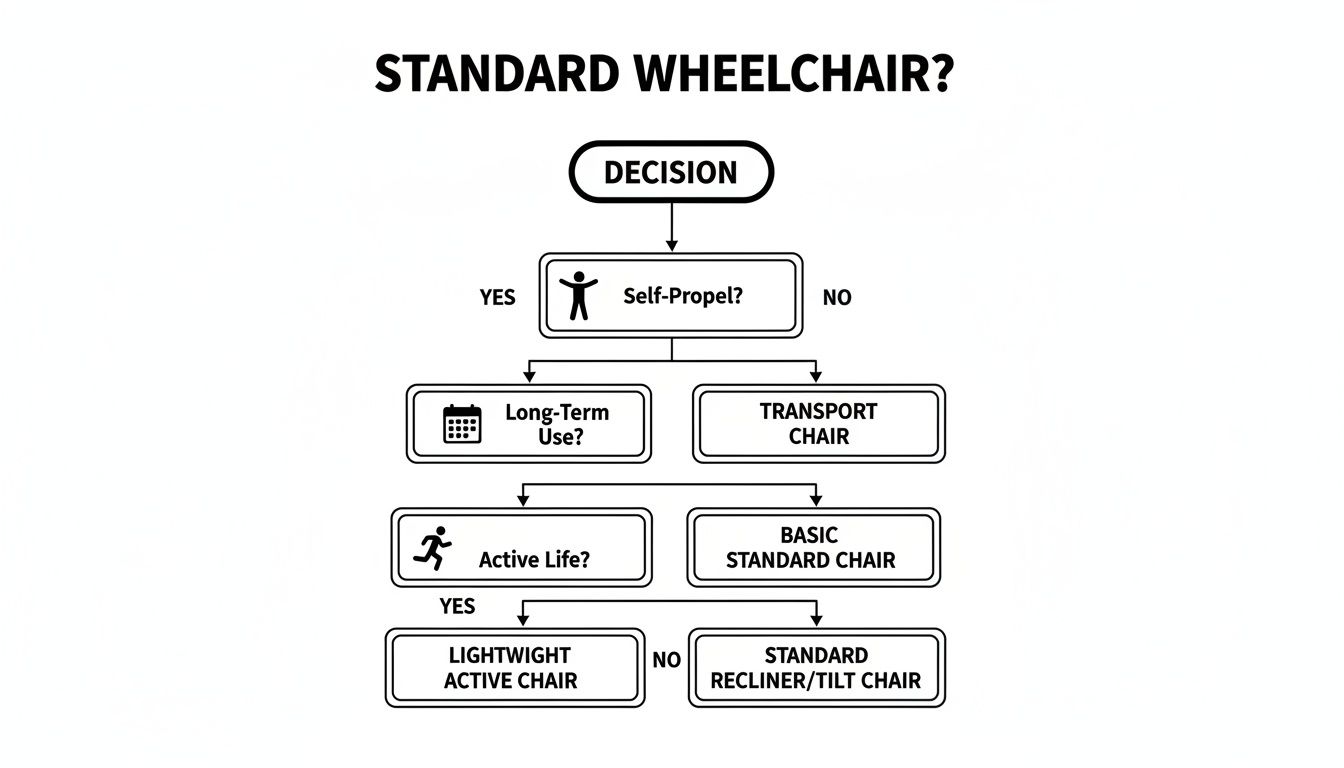
The flowchart breaks the decision down by asking key questions about self-propulsion, long-term needs, and lifestyle, guiding you straight to the best option for your situation.
Understanding Payment and Accessibility
We want to make getting the right equipment as simple and clear as possible. That's why we do not partner with insurance providers. Instead, we focus on direct, transparent pricing. You know the exact cost from the start, with no confusing claims or long waits for approval. This means you can get the help you need, right when you need it.
A professional fitting is crucial for both safety and comfort. An improperly sized wheelchair can cause poor posture, pressure sores, and difficulty with propulsion or pushing. Our team can help ensure the seat width, depth, and height are perfectly matched to the user.
Globally, getting a wheelchair can be incredibly difficult. The World Health Organization estimates that while 80 million people need them, many go without due to high costs and lack of access. This is a huge issue, and you can learn more about these wheelchair market challenges and accessibility issues. We see it as our job to help bridge that gap in our community by offering straightforward sales and rentals, ensuring you can find a solution that fits both your life and your budget.
Common Questions About Wheelchairs
Even after laying out the differences, it's normal to still have a few questions when you're deciding between a transport wheelchair vs. a standard wheelchair. Getting this right is a big deal—it affects comfort, safety, and just getting through the day. We've gathered some of the most common questions we hear from customers to give you clear, straightforward answers.
Our aim is to make sure you feel totally confident in your choice. If you don't see your question here, our full FAQ page has plenty more information.
Can a Transport Wheelchair Be Used for Long Distances?
A transport wheelchair is really built for short trips. Think of it as the perfect tool for getting from the car to the doctor's office or weaving through the aisles at the grocery store.
Its smaller wheels and light frame are designed for easy portability and navigating tight spots, not for covering a lot of ground. For the person pushing, going long distances or over uneven terrain can be exhausting, and it's not the most comfortable ride for the user either. If longer excursions or independence are part of the plan, a standard wheelchair is the far better and more comfortable option.
Is It Possible to Self-Propel a Transport Wheelchair?
No, you absolutely cannot self-propel a transport wheelchair. It’s not just impractical—it’s unsafe. The small back wheels are intentionally positioned out of the user's reach and simply aren't made for gripping and pushing.
Trying to move the chair yourself could easily cause it to become unstable or tip, leading to an injury. These chairs are designed from the ground up to be pushed safely by a companion or caregiver, and that's their only intended use.
The entire design of a transport wheelchair is built around caregiver control. Any attempt by the user to self-propel it undermines its fundamental safety and intended function.
Which Wheelchair Is Better for Travel and Portability?
When it comes to travel, the transport wheelchair wins, hands down. They are much lighter, typically weighing between 15 and 25 pounds, and they fold down into a really compact shape.
This makes them incredibly easy to lift into a car trunk, take on a bus, or store in a closet. While most standard wheelchairs also fold, their heavier weight (often 35 to 50 pounds) and larger size make them a lot more cumbersome to manage if you're traveling frequently.
Do I Need a Special Vehicle to Transport These Wheelchairs?
The good news is you don't need a special vehicle for either a foldable transport chair or a standard one. Most are designed to fit just fine in the trunk of an average car.
The real difference, though, is how easy they are to handle. A transport wheelchair's significantly lighter weight and tighter fold make it much easier for one person to load and unload without straining. This simple convenience is one of the main reasons they're so popular for people who are out and about with a caregiver.
At Affinity Home Medical Equipment, our focus is on getting you the right mobility solution without the usual runaround. We do not accept insurance, which allows us to provide clear pricing and same-day access to the equipment you need. For expert advice or to explore our selection, visit us online at https://affinityhomemedicalequipment.com.
Share This Article

Written by : Rich affinityrich@gmail.com
Follow Us
Latest Articles

October 14, 2026

October 14, 2026

October 14, 2026
